<?xml version="1.0" encoding="utf-8"?>
<feed xmlns="http://www.w3.org/2005/Atom" xmlns:media="http://search.yahoo.com/mrss/">
    <title>Wissenschaft + Kommunikation</title>
    <link href="https://droste-effect.com/feed.xml" rel="self" />
    <link href="https://droste-effect.com" />
    <updated>2026-10-29T19:44:33+01:00</updated>
    <author>
        <name>Heinz W. Droste</name>
    </author>
    <id>https://droste-effect.com</id>

    <entry>
        <title>The &quot;All-Crusher&quot; Myth and the Grand Illusion of Immanuel Kant</title>
        <author>
            <name>Heinz W. Droste</name>
        </author>
        <link href="https://droste-effect.com/the-all-crusher-myth-and-the-grand-illusion-of-immanuel-kant/"/>
        <id>https://droste-effect.com/the-all-crusher-myth-and-the-grand-illusion-of-immanuel-kant/</id>
        <media:content url="https://droste-effect.com/media/posts/122/Episode91Aufmacher.jpg" medium="image" />
            <category term="Wissenschaftstheorie"/>

        <updated>2026-10-01T12:34:53+02:00</updated>
            <summary type="html">
                <![CDATA[
                        <img src="https://droste-effect.com/media/posts/122/Episode91Aufmacher.jpg" alt="" />
                    Deconstructing the Mandarin of Königsberg #9 Over the past eight weeks, we have undertaken an uncompromising, evidence-based expedition through&hellip;
                ]]>
            </summary>
        <content type="html">
            <![CDATA[
                    <p><img src="https://droste-effect.com/media/posts/122/Episode91Aufmacher.jpg" class="type:primaryImage" alt="" /></p>
                <h4 class="wp-block-heading">Deconstructing the Mandarin of Königsberg #9</h4>
<p id="p-rc_2d622ded0b7e6107-290" data-path-to-node="3"><span data-path-to-node="3,0">Over the past eight weeks, we have undertaken an uncompromising, evidence-based expedition through the intellectual fortress of Immanuel Kant</span><span data-path-to-node="3,2">. We dismantled the myth of the scientific genius, exposing his physical and cosmological errors</span><span data-path-to-node="3,4">. We revealed that his "awakening from dogmatic slumber" was a strategic retreat to protect Lutheran morality from empirical skepticism</span><span data-path-to-node="3,6">. We showed how his "Copernican Revolution" was, in fact, a solipsistic Ptolemaic relapse that trapped human cognition inside its own subjective simulation</span><span data-path-to-node="3,8">. We put the Categorical Imperative on trial, uncovering its anti-empathetic, authoritarian nature, and exposed the theological "God-Bias" that led Kant to formulate an explicit hierarchy of intellectual racism</span><span data-path-to-node="3,10">. Finally, we introduced Mario Bunge's Agathonism as a secular, scientifically grounded compass for the 21st century</span><span data-path-to-node="3,12">.</span></p>
<p id="p-rc_2d622ded0b7e6107-291" data-path-to-node="4"><span data-path-to-node="4,0">Yet, as we conclude the core of this series and look back at the sheer volume of memes and myths that have insulated Kant’s legacy—especially within the German-speaking cultural sphere—one overarching myth still demands a definitive deconstruction</span><span data-path-to-node="4,2">. It is the ultimate title bestowed upon Kant by academia: Kant, the "All-Crusher" (<i data-path-to-node="4,2" data-index-in-node="84">Der Alleszermalmer</i>)</span><span data-path-to-node="4,4">.</span></p>
<h4 data-path-to-node="5">The Legend of the "All-Crusher"</h4>
<p id="p-rc_2d622ded0b7e6107-292" data-path-to-node="6"><span data-path-to-node="6,0">In university lectures and standard histories of philosophy, Kant is routinely celebrated as the <i data-path-to-node="6,0" data-index-in-node="97">Alleszermalmer</i>—the relentless intellectual giant who decisively crushed the outdated, dogmatic metaphysics of his predecessors</span><span data-path-to-node="6,2">. This intimidating title suggests an unparalleled philosophical brilliance, a thinker who single-handedly demolished the old world to build a new era of critical reason</span><span data-path-to-node="6,4">.</span></p>
<p id="p-rc_2d622ded0b7e6107-293" data-path-to-node="7"><span data-path-to-node="7,0">The origin of this legendary epithet is invariably traced back to Moses Mendelssohn, one of the most prominent Jewish Enlightenment philosophers of the 18th century</span><span data-path-to-node="7,2">. The standard narrative claims that Mendelssohn, in awe of Kant’s devastating critique of traditional metaphysics, respectfully bowed to Kant's destructive genius, christening him the "all-crushing Kant."</span></p>
<p id="p-rc_2d622ded0b7e6107-294" data-path-to-node="8"><span data-path-to-node="8,0">There is only one problem with this narrative: It is a complete historical distortion</span><span data-path-to-node="8,2">.</span></p>
<p id="p-rc_2d622ded0b7e6107-295" data-path-to-node="9"><span data-path-to-node="9,0">When we examine the actual letters and texts of Moses Mendelssohn, we discover that the title "All-Crusher" was not a professional assessment of Kant’s philosophical superiority</span><span data-path-to-node="9,2">. It was an expression of deep medical frustration and intellectual exhaustion</span><span data-path-to-node="9,4">.</span></p>
<h4 data-path-to-node="10">The Medical Reality Behind the Myth</h4>
<p id="p-rc_2d622ded0b7e6107-296" data-path-to-node="11"><span data-path-to-node="11,0">To understand the true context, we must look at the correspondence between Kant and Mendelssohn, and Mendelssohn’s final work, <i data-path-to-node="11,0" data-index-in-node="127">Morgenstunden</i> (1785)</span><span data-path-to-node="11,2">.</span></p>
<p id="p-rc_2d622ded0b7e6107-297" data-path-to-node="12"><span data-path-to-node="12,0">When Kant published the <i data-path-to-node="12,0" data-index-in-node="24">Critique of Pure Reason</i> in 1781, it was met with total public silence</span><span data-path-to-node="12,2">. Desperate to generate academic discourse, Kant specifically targeted Mendelssohn, sending him a dedicated copy and hoping the famous Berliner would champion the work</span><span data-path-to-node="12,4">. But Mendelssohn laid the book aside</span><span data-path-to-node="12,6">.</span></p>
<p id="p-rc_2d622ded0b7e6107-298" data-path-to-node="13"><span data-path-to-node="13,0">In a letter to Kant in April 1783, Mendelssohn finally explained why: he was suffering from a severe "nervous weakness" (<i data-path-to-node="13,0" data-index-in-node="121">Nervenschwäche</i>)</span><span data-path-to-node="13,2">. This neurological and psychological exhaustion made rigorous mental exertion impossible for him</span><span data-path-to-node="13,4">. He confessed to Kant that he had been "dead to metaphysics" for years, noting that reading the complex thoughts of others had become even more difficult for him than generating his own</span><span data-path-to-node="13,6">. He referred to Kant’s <i data-path-to-node="13,6" data-index-in-node="24">Critique</i> not as a brilliant revelation, but as a <i data-path-to-node="13,6" data-index-in-node="73">"work that consumes the nervous fluid"</i> (<i data-path-to-node="13,6" data-index-in-node="113">Nervensaft verzehrendes Werk</i>)</span><span data-path-to-node="13,8">.</span></p>
<p id="p-rc_2d622ded0b7e6107-299" data-path-to-node="14"><span data-path-to-node="14,0">Two years later, in the introduction to <i data-path-to-node="14,0" data-index-in-node="40">Morgenstunden</i>, Mendelssohn publicly confirmed his condition, stating that his nervous weakness forbade him from any mental exertion</span><span data-path-to-node="14,2">. He explicitly admitted that he had not kept up with the science of metaphysics since 1775—long before Kant’s <i data-path-to-node="14,2" data-index-in-node="111">Critique</i> was even published</span><span data-path-to-node="14,4">.</span></p>
<p id="p-rc_2d622ded0b7e6107-300" data-path-to-node="15"><span data-path-to-node="15,0">It is in this exact context of admitting his own cognitive limitations that Mendelssohn writes</span><span data-path-to-node="15,2">:</span></p>
<blockquote data-path-to-node="16">
<p data-path-to-node="16,0"><i data-path-to-node="16,0" data-index-in-node="0">"I therefore know the writings of the great men who have in the meantime distinguished themselves in metaphysics—the works of Lambert, Tetens, Platner, and even of the all-crushing Kant—only through the inadequate reports of my friends or through learned notices..."</i></p>
<p id="p-rc_2d622ded0b7e6107-301" data-path-to-node="16,1"></p>
</blockquote>
<h4 data-path-to-node="17">A Crushing of Concentration, Not Philosophy</h4>
<p id="p-rc_2d622ded0b7e6107-302" data-path-to-node="18"><span data-path-to-node="18,0">When Mendelssohn called Kant the <i data-path-to-node="18,0" data-index-in-node="33">Alleszermalmer</i>, he was not praising Kant's philosophical success in destroying dogmatic metaphysics</span><span data-path-to-node="18,2">. He was expressing his own personal overwhelm</span><span data-path-to-node="18,4">. Kant’s convoluted, impenetrable prose—what Heinrich Heine later mocked as a "gray, dry, brown-paper style"—simply crushed Mendelssohn's fragile capacity for concentration</span><span data-path-to-node="18,6">.</span></p>
<p id="p-rc_2d622ded0b7e6107-303" data-path-to-node="19"><span data-path-to-node="19,0">The "crushing" referred to the sheer, exhausting cognitive burden of reading the text, an experience shared by almost everyone who attempted to read the <i data-path-to-node="19,0" data-index-in-node="153">Critique</i> upon its release</span><span data-path-to-node="19,2">. To derive the heroic title "All-Crusher of previous philosophy" from an ailing man's admission of reading fatigue is not just absurd; it is completely contrary to the historical facts</span><span data-path-to-node="19,4">.</span></p>
<p id="p-rc_2d622ded0b7e6107-304" data-path-to-node="20"><span data-path-to-node="20,0">Furthermore, as we established in Chapter 3 of <i data-path-to-node="20,0" data-index-in-node="47">The Long Farewell to Immanuel Kant</i>, Kant did not actually crush traditional metaphysics</span><span data-path-to-node="20,2">. Through the subsequent PR-campaign led by Karl Leonhard Reinhold, Kant’s work was explicitly popularized as a conservative <i data-path-to-node="20,2" data-index-in-node="125">defense</i> of religion, designed to protect traditional Lutheran values and the concept of God from the radical, materialist Enlightenment thinkers of France</span><span data-path-to-node="20,4">. Kant was not the destroyer of dogma; he was its most sophisticated restorer</span><span data-path-to-node="20,6">.</span></p>
<h4 data-path-to-node="21">Conclusion: Breaking the Spell</h4>
<p id="p-rc_2d622ded0b7e6107-305" data-path-to-node="22"><span data-path-to-node="22,0">The myth of the <i data-path-to-node="22,0" data-index-in-node="16">Alleszermalmer</i> perfectly encapsulates the broader phenomenon of the Kant-Mythos</span><span data-path-to-node="22,2">. It demonstrates how the German cultural sphere—desperate for an intellectual "National Saint"—has consistently stripped Kant's history of its context, transforming mundane realities, poor writing styles, and theological rescue missions into legendary philosophical triumphs</span><span data-path-to-node="22,4">.</span></p>
<p id="p-rc_2d622ded0b7e6107-306" data-path-to-node="23"><span data-path-to-node="23,0">The memes we have deconstructed over these nine parts are not harmless academic traditions</span><span data-path-to-node="23,2">. They act as "cognitive prostheses" that prevent us from thinking critically and scientifically about the world</span><span data-path-to-node="23,4">. By shedding these illusions, we open the door to a genuine, evidence-based Enlightenment</span><span data-path-to-node="23,6">.</span></p>
<p data-path-to-node="23"> </p>
<p> </p>
<h3>Where to Obtain the Book, eBook &amp; AI-Audiobook</h3>
<figure class="post__image post__image--center"><img loading="lazy"  src="https://droste-effect.com/media/posts/122/FreistellerFokus-300x223.jpg" alt="" width="300" height="223" sizes="(max-width: 1200px) 100vw, 1200px" srcset="https://droste-effect.com/media/posts/122/responsive/FreistellerFokus-300x223-xs.jpg 300w ,https://droste-effect.com/media/posts/122/responsive/FreistellerFokus-300x223-sm.jpg 480w ,https://droste-effect.com/media/posts/122/responsive/FreistellerFokus-300x223-md.jpg 768w ,https://droste-effect.com/media/posts/122/responsive/FreistellerFokus-300x223-xl.jpg 1200w ,https://droste-effect.com/media/posts/122/responsive/FreistellerFokus-300x223-xxl.jpg 1600w ,https://droste-effect.com/media/posts/122/responsive/FreistellerFokus-300x223-xxxl.jpg 2560w"></figure>
<p>The full, uncompromised investigation is available now across international formats:</p>
<ul>
<li>📚 <strong>Paperback Edition:</strong> Available via major booksellers and online retailers. 👉 <a href="https://www.amazon.de/stores/Heinz-W.-Droste/author/B001K1OFRW?ref=ap_rdr&amp;shoppingPortalEnabled=true" target="_blank" rel="noopener">Order the Paperback on Amazon / Booksellers</a></li>
<li>📱 <strong>eBook Edition (Kindle / ePub):</strong> Instantly downloadable for e-readers and digital libraries. 👉 <a href="https://www.amazon.de/stores/Heinz-W.-Droste/author/B001K1OFRW?ref=ap_rdr&amp;shoppingPortalEnabled=true" target="_blank" rel="noopener">Get the Digital eBook Edition</a></li>
<li>🎧 <strong>AI-Voiced Audiobook (ElevenReader):</strong> Listen to the professionally voiced audiobook edition directly on ElevenReader. 👉 <a href="https://elevenreader.io/audiobooks/the-long-farewell-to-immanuel-kant-audiobook/7WQgYKx5fs2bCnHN2K9w" target="_blank" rel="noopener">Listen to the Audiobook on ElevenReader</a></li>
<li>📰 <strong>Press Center &amp; Review Copies:</strong> Journalists, reviewers, and podcast hosts canhttps://a-g-i-l.de/abschied-fuer-presse/ access full press releases, media kits, and sample chapters on the official press page: 👉 <a href="https://droste-effect.com/abschied-fuer-presse/">Visit the Official Kant Press Center</a></li>
</ul>
<p> </p>
<div class="wp-block-buttons">
<div class="wp-block-button has-custom-width wp-block-button__width-75 is-style-fill"><a class="wp-block-button__link has-theme-palette-14-background-color has-background align-center has-medium-font-size has-custom-font-size wp-element-button" href="https://tideturn.substack.com">Subscribe to my Substack Newsletter for deep dives</a></div>
<p> </p>
</div>
<p> </p>
<p> </p>
<p> </p>
<p> </p>
            ]]>
        </content>
    </entry>
    <entry>
        <title>Remembering Mario Bunge: The Public Intellectual Who Tackled Big Questions</title>
        <author>
            <name>Heinz W. Droste</name>
        </author>
        <link href="https://droste-effect.com/remembering-mario-bunge-the-public-intellectual-who-tackled-big-questions/"/>
        <id>https://droste-effect.com/remembering-mario-bunge-the-public-intellectual-who-tackled-big-questions/</id>
        <media:content url="https://droste-effect.com/media/posts/121/MarioBunge09212026.jpg" medium="image" />
            <category term="Wissenschaftstheorie"/>

        <updated>2026-09-21T10:40:32+02:00</updated>
            <summary type="html">
                <![CDATA[
                        <img src="https://droste-effect.com/media/posts/121/MarioBunge09212026.jpg" alt="" />
                    Remembering Mario Bunge: The Public Intellectual Who Tackled Big Questions By Heinz W. Droste Published on September 21, 2026&hellip;
                ]]>
            </summary>
        <content type="html">
            <![CDATA[
                    <p><img src="https://droste-effect.com/media/posts/121/MarioBunge09212026.jpg" class="type:primaryImage" alt="" /></p>
                <h1 class="wp-block-heading">Remembering Mario Bunge: The Public Intellectual Who Tackled Big Questions</h1>
<p><strong>By Heinz W. Droste</strong><br><em>Published on September 21, 2026</em></p>
<hr class="separator">
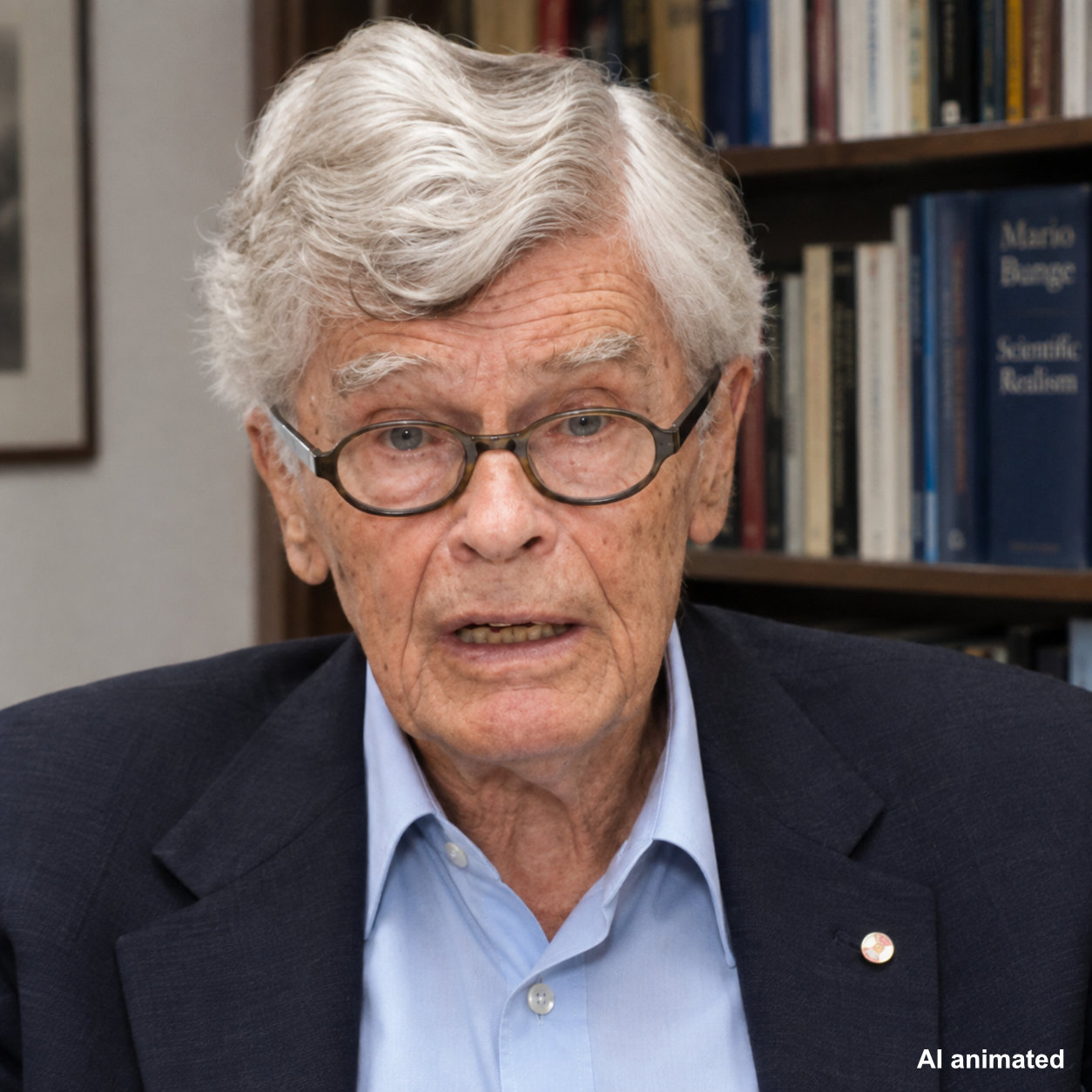
<p>On September 21, the international scientific and philosophical community marks the birthday of <strong>Mario Augusto Bunge</strong> (September 21, 1919 – February 24, 2020). On the occasion of his 100th birthday, I had the privilege of contributing a chapter entitled <em>"Mario Bunge as a Public Intellectual"</em> to his centenary festschrift, <em>Mario Bunge: A Centenary Festschrift</em> (edited by Michael R. Matthews and published by Springer). Today, as we reflect on his legacy, Bunge’s uncompromising defense of rationalism, scientific realism, and social responsibility remains as urgent and illuminating as ever.</p>
<hr class="separator">
<h2 class="wp-block-heading">The Philosopher as a Public Intellectual</h2>
<p>What distinguishes Mario Bunge from so many contemporary academic philosophers is that he never retreated into "otherworldly niches" or settled for merely writing comments on other commentators. Trained as a theoretical physicist and philosopher, Bunge viewed philosophy not as an abstract parlor game, but as an actionable, systemic <strong>"truth technology"</strong>. This comprehensive framework embraced ontology, epistemology, methodology, ethics, and political philosophy to engage directly with the pressing issues of humanity.</p>
<p>Throughout his long and remarkably prolific career—authoring over 80 books and 500 scientific papers—Bunge operated in the tradition of the radical secular Enlightenment. As early as age 19, he demonstrated his commitment to popular education and social justice by founding the <em>Universidad Obrera Argentina</em> (Argentine Workers’ University) to provide free technical and humanities education to industrial workers.</p>
<p>Whether challenging pseudo-scientific pretensions in academia, confronting Nobel laureates on dualism—such as his famous intervention against Sir John Eccles’ mind-body dualism at the 1978 World Congress of Philosophy in Düsseldorf—or criticizing flawed economic models during global financial crises, Bunge acted as a fearless public intellectual who "took no prisoners" when fighting for reason.</p>
<blockquote class="wp-block-quote">
<p><em>"A philosophy is worth what it helps learn, act, conserve our common heritage, and get along with fellow humans."</em><br>— <strong>Mario Bunge</strong></p>
</blockquote>
<hr class="separator">
<h2 class="wp-block-heading">"The Big Questions Come in Bundles"</h2>
<p>One of Bunge’s core insights is that reality is systemic. Isolated problems are an illusion; genuine scientific and philosophical inquiries are interconnected. As Bunge famously emphasized in our extensive interview:</p>
<blockquote class="wp-block-quote">
<p><strong>"The Big Questions come in bundles, not one at a time."</strong></p>
</blockquote>
<p>In this in-depth exchange, Bunge shared his incisive perspectives across a vast spectrum of modern thought:</p>
<ul class="wp-block-list">
<li><strong>On the Role of Philosophy:</strong> He rejected "instant philosophy" or 120-second elevator pitches, arguing that fundamental human issues like truth and justice require rigorous, long-term systemic analysis.</li>
<li><strong>On Science and Pseudoscience:</strong> Bunge provided laymen with clear criteria to spot and reject pseudoscientific fantasies—ranging from psychoanalysis, homeopathy, and acupuncture to uncritical cosmological myths like creation out of nothing or multiverses lacking empirical evidence.</li>
<li><strong>On Mind, Neuroscience, and Free Will:</strong> Grounding his emergent materialism in cognitive neuroscience, Bunge explained how material brain processes support genuine free will through spontaneous neural activity without resorting to non-material mind theories.</li>
<li><strong>On Modern Technology and Social Bonds:</strong> With remarkable foresight, Bunge critiqued the overuse of smartphones and digital devices, warning that text-messaging trivialities undermines authentic face-to-face interaction, which remains essential for love, friendship, and genuine human collaboration.</li>
<li><strong>On the Enlightenment:</strong> He called for a periodic revamping of Enlightenment ideals to tackle modern challenges like technological unemployment and environmental degradation, sharply opposing postmodernists and the Frankfurt School who rejected Enlightenment rationality altogether.</li>
</ul>
<p>👉 <strong>Read the full interview here:</strong> <a href="https://www.google.com/url?sa=E&amp;q=https%3A%2F%2Fa-g-i-l.de%2Fmario-bunge-the-big-questions-come-in-bundles-not-one-at-time%2F">Mario Bunge: The Big Questions come in bundles, not one at a time</a></p>
<hr class="separator">
<h2 class="wp-block-heading">A Lasting Compass for Rational Thought</h2>
<p>As we honor Mario Bunge on his birthday, his work serves as an indispensable compass in an era increasingly threatened by misinformation, irrationalism, and superficial noise Bunge proved that rigorous scientific thinking and passionate public engagement are not mutually exclusive—they are two sides of the same enlightened endeavor.</p>
<p>For those interested in exploring Bunge's systematic philosophy further, my book <em>Turn of the Tide – Gezeitenwechsel: Einführung in Mario Bunges exakte Philosophie</em> <a href="#non-existing-page-with-id-194">(Pedion Verlag)</a> offers a comprehensive introduction to his exact philosophy.</p>
<p>Let us celebrate Mario Bunge’s enduring legacy by keeping our enthusiasm tempered with caution, planting seeds of rational inquiry, and tackling the big questions with systemic vision.</p>
<hr class="separator">
<p><strong>Categories:</strong> Philosophy of Science, Public Intellectuals, Enlightenment, Systemism</p>
            ]]>
        </content>
    </entry>
    <entry>
        <title>A New Compass for the 21st Century—Moving Beyond the Dictatorship of Reason</title>
        <author>
            <name>Heinz W. Droste</name>
        </author>
        <link href="https://droste-effect.com/a-new-compass-for-the-21st-century-moving-beyond-the-dictatorship-of-reason/"/>
        <id>https://droste-effect.com/a-new-compass-for-the-21st-century-moving-beyond-the-dictatorship-of-reason/</id>
        <media:content url="https://droste-effect.com/media/posts/120/Episode8_Aufmacher.jpg" medium="image" />
            <category term="Kant-Kritik"/>

        <updated>2026-09-17T19:20:36+02:00</updated>
            <summary type="html">
                <![CDATA[
                        <img src="https://droste-effect.com/media/posts/120/Episode8_Aufmacher.jpg" alt="" />
                    Deconstructing the Mandarin of Königsberg #8 Over the past seven weeks, we have embarked on a rigorous, evidence-based expedition&hellip;
                ]]>
            </summary>
        <content type="html">
            <![CDATA[
                    <p><img src="https://droste-effect.com/media/posts/120/Episode8_Aufmacher.jpg" class="type:primaryImage" alt="" /></p>
                <h4 class="wp-block-heading">Deconstructing the Mandarin of Königsberg #8</h4>
<p>Over the past seven weeks, we have embarked on a rigorous, evidence-based expedition through the formidable intellectual fortress of Immanuel Kant. We have systematically dismantled the myths that have insulated his legacy from modern scientific and moral scrutiny.</p>
<p>We exposed his cosmological models as mathematically flawed. We revealed that his "awakening from dogmatic slumber" was not a leap toward empirical science, but a strategic retreat to protect Lutheran theology from skepticism. We demonstrated how his "Copernican Revolution" was actually a solipsistic, Ptolemaic relapse that trapped human cognition inside its own subjective simulation. We saw how his Categorical Imperative ignores human moral psychology, and how his "God-Bias" provided a philosophical justification for intellectual racism and authoritarian obedience.</p>
<p>Now, we reach the grand finale. The question that naturally arises is: If we dethrone the "Giant of the Enlightenment," what takes his place? If we dismantle the Kantian cognitive prosthesis, how do we orient ourselves in the 21st century?</p>
<p>The answer is both simple and profoundly liberating: We must permanently bid farewell to the "dictatorship of reason" and embrace a secular, scientifically grounded ethic that actually serves humanity.</p>
<p><strong>The Opportunity Costs of the Kantian Myth</strong></p>
<p>Before we introduce a new compass, we must acknowledge the massive opportunity costs of continuously, uncritically replicating Kantian concepts in modern academia and public discourse.</p>
<p>When we cling to Kant's transcendental idealism, we actively block the integration of modern physics (such as relativity and quantum mechanics), cognitive neuroscience, and rationality research (like the predictive processing of the human brain). When we treat his ethics of duty as the gold standard, we stifle genuine moral progress, reducing ethics to abstract, disembodied compliance rather than focusing on the tangible reduction of human suffering and the real-world consequences of our actions.</p>
<p>Kant demanded that we free ourselves from "self-incurred immaturity," yet his own philosophical system became the ultimate "book that thinks for us"—a static dogma that demands obedience to an otherworldly law rather than autonomous, empirical investigation. True Enlightenment means having the courage to leave Kant behind.</p>
<p><strong>A New Compass: Mario Bunge and Scientific Realism</strong></p>
<p>To navigate the complexities of the 21st century, we do not need 18th-century theological metaphysics disguised as pure reason. We need a philosophy that is fully integrated with the exact sciences—biology, sociology, physics, and psychology.</p>
<p>We find this in the work of modern exact philosophers, most notably the Argentine-Canadian physicist and philosopher <strong>Mario Bunge</strong>. Bunge’s philosophy is grounded in <em>scientific realism</em> and <em>systemism</em>: the understanding that an objective, material universe exists independently of our consciousness, and that human beings are complex biological and social systems deeply interconnected with their environment.</p>
<p>Unlike Kant, who split the human being into a physically determined animal and a transcendentally free spirit, modern exact philosophy treats the human being as a unified, evolving entity whose thoughts, emotions, and moral intuitions are the products of neural processes and social history.</p>
<p><strong>Agathonism: "Enjoy Life and Help Live"</strong></p>
<p>The most liberating replacement for Kant’s austere, authoritarian Categorical Imperative is Bunge’s ethical framework, known as <strong>Agathonism</strong>.</p>
<p>Agathonism abandons the rigid, emotionless duty-fetish of deontology. Instead of demanding blind obedience to an abstract universal law regardless of the consequences, Agathonism proposes a deeply humanistic, empirically informed moral maxim:</p>
<blockquote class="wp-block-quote">
<p><strong><em>"Enjoy life and help live."</em></strong></p>
<p> </p>
</blockquote>
<p>This simple yet profound principle bridges the gap between individual well-being and social responsibility. It asserts that:</p>
<ol class="wp-block-list" start="1">
<li><strong>Rights and Duties are Inseparable:</strong> We have a right to pursue our own happiness and self-realization, but this is fundamentally coupled with the duty to actively help others achieve the same.</li>
<li><strong>Consequentialism Matters:</strong> Unlike Kantian ethics, which ignores outcomes, Agathonism demands that we evaluate our actions based on their actual, measurable impact on human well-being and society.</li>
<li><strong>Rooted in Reality, Not Theology:</strong> We do not need a transcendent "world-ruler," a postulate of immortality, or an <em>a priori</em> command to act morally. Human empathy, biological cooperation, and rational problem-solving are sufficient foundations for a just society.</li>
</ol>
<p><strong>The Ultimate Call to Autonomy</strong></p>
<p>Giving up Immanuel Kant’s philosophy is the most liberating intellectual step you can take. It frees your mind from the solipsistic trap of transcendental idealism. It frees your morality from the cold, punitive grip of abstract duty. It frees your politics from the authoritarian demand for unconditional obedience.</p>
<p>The Enlightenment is not a finished, static monument to be worshipped; it is an ongoing, dynamic process of scientific and moral discovery. It is time to drop the 18th-century cognitive prosthesis and step into the real world.</p>
<p> </p>
<p> </p>
<p> </p>
<h3>Where to Obtain the Book, eBook &amp; AI-Audiobook</h3>
<figure class="post__image post__image--center"><img loading="lazy"  src="https://droste-effect.com/media/posts/120/FreistellerFokus-300x223.jpg" alt="" width="300" height="223" sizes="(max-width: 1200px) 100vw, 1200px" srcset="https://droste-effect.com/media/posts/120/responsive/FreistellerFokus-300x223-xs.jpg 300w ,https://droste-effect.com/media/posts/120/responsive/FreistellerFokus-300x223-sm.jpg 480w ,https://droste-effect.com/media/posts/120/responsive/FreistellerFokus-300x223-md.jpg 768w ,https://droste-effect.com/media/posts/120/responsive/FreistellerFokus-300x223-xl.jpg 1200w ,https://droste-effect.com/media/posts/120/responsive/FreistellerFokus-300x223-xxl.jpg 1600w ,https://droste-effect.com/media/posts/120/responsive/FreistellerFokus-300x223-xxxl.jpg 2560w"></figure>
<p>The full, uncompromised investigation is available now across international formats:</p>
<ul>
<li>📚 <strong>Paperback Edition:</strong> Available via major booksellers and online retailers. 👉 <a href="https://www.amazon.de/stores/Heinz-W.-Droste/author/B001K1OFRW?ref=ap_rdr&amp;shoppingPortalEnabled=true" target="_blank" rel="noopener">Order the Paperback on Amazon / Booksellers</a></li>
<li>📱 <strong>eBook Edition (Kindle / ePub):</strong> Instantly downloadable for e-readers and digital libraries. 👉 <a href="https://www.amazon.de/stores/Heinz-W.-Droste/author/B001K1OFRW?ref=ap_rdr&amp;shoppingPortalEnabled=true" target="_blank" rel="noopener">Get the Digital eBook Edition</a></li>
<li>🎧 <strong>AI-Voiced Audiobook (ElevenReader):</strong> Listen to the professionally voiced audiobook edition directly on ElevenReader. 👉 <a href="https://elevenreader.io/audiobooks/the-long-farewell-to-immanuel-kant-audiobook/7WQgYKx5fs2bCnHN2K9w" target="_blank" rel="noopener">Listen to the Audiobook on ElevenReader</a></li>
<li>📰 <strong>Press Center &amp; Review Copies:</strong> Journalists, reviewers, and podcast hosts canhttps://a-g-i-l.de/abschied-fuer-presse/ access full press releases, media kits, and sample chapters on the official press page: 👉 <a href="https://droste-effect.com/abschied-fuer-presse/">Visit the Official Kant Press Center</a></li>
</ul>
<p> </p>
<div class="wp-block-buttons">
<p> </p>
<div class="wp-block-button has-custom-width wp-block-button__width-75 is-style-fill"><a class="wp-block-button__link has-theme-palette-14-background-color has-background align-center has-medium-font-size has-custom-font-size wp-element-button" href="https://tideturn.substack.com">Subscribe to my Substack Newsletter for deep dives</a></div>
<p> </p>
</div>
<p> </p>
<p> </p>
<p> </p>
<p> </p>
            ]]>
        </content>
    </entry>
    <entry>
        <title>Kant’s Authoritarian State</title>
        <author>
            <name>Heinz W. Droste</name>
        </author>
        <link href="https://droste-effect.com/kants-authoritarian-state/"/>
        <id>https://droste-effect.com/kants-authoritarian-state/</id>
        <media:content url="https://droste-effect.com/media/posts/119/Episode8Aufmacher.jpg" medium="image" />
            <category term="Kant-Kritik"/>

        <updated>2026-09-10T14:55:44+02:00</updated>
            <summary type="html">
                <![CDATA[
                        <img src="https://droste-effect.com/media/posts/119/Episode8Aufmacher.jpg" alt="" />
                    Deconstructing the Mandarin of Königsberg # 7 Over the past six weeks, we have systematically dismantled the intellectual fortress&hellip;
                ]]>
            </summary>
        <content type="html">
            <![CDATA[
                    <p><img src="https://droste-effect.com/media/posts/119/Episode8Aufmacher.jpg" class="type:primaryImage" alt="" /></p>
                <h3 class="wp-block-heading">Deconstructing the Mandarin of Königsberg # 7</h3>
<p>Over the past six weeks, we have systematically dismantled the intellectual fortress of Immanuel Kant. We have exposed his physical and cosmological errors, stripped away the solipsistic illusion of his transcendental idealism, and revealed the rigid, anti-empirical nature of his duty-bound ethics. We have even uncovered the dark theological trap that led the "Giant of the Enlightenment" to formulate an explicit hierarchy of intellectual racism.</p>
<p>Now, as we approach the conclusion of this series, we must confront the ultimate socio-political fallout of his system: if Kant’s epistemology isolates us from reality and his ethics divorces us from empathy, what is the ultimate consequence of his political philosophy?</p>
<p>In modern political discourse, Kant is frequently heralded as a visionary pioneer of human rights, international peace, and modern democratic theory. A rigorous examination of his political and legal texts, however, completely shatters this narrative. Kant’s political philosophy is not a blueprint for emancipation; it is the ultimate philosophical justification for an authoritarian "dictatorship of reason" that demands unconditional obedience and categorically rejects democratic self-determination.</p>
<p><strong>The Anti-Democratic Core of Kantian Politics</strong></p>
<p>To understand the political danger of Kant's philosophy, one must look past his abstract musings on perpetual peace and examine his concrete legal doctrines, particularly in his 1797 work, <em>The Metaphysics of Morals</em>.</p>
<p>While radical Enlightenment thinkers in France and America—such as Baron d'Holbach, Denis Diderot, and Thomas Paine—were arguing that political legitimacy derives solely from the consent of the governed, Kant adopted a fiercely conservative, restorative position. He explicitly rejected democracy, notoriously labeling it a form of "despotism." In Kant's rigidly formalistic view, democracy inherently establishes an executive power where all can make decisions about one, which violates his theoretical separation of powers.</p>
<p>More disturbingly, Kant served as the ultimate philosophical defender of the Prussian authoritarian state. He maintained that subjects possess no defensible right of resistance against their rulers, regardless of how tyrannical, unjust, or murderous those rulers might be. For Kant, the sovereign’s authority is absolute. Rebellion or revolution is framed not merely as a political crime, but as a supreme moral transgression that destroys the very legal framework of reason.</p>
<p>Kant demanded that citizens separate their inner, "intelligible" freedom from their outward, "empirical" civic duty: you may possess moral autonomy in your private conscience, but you must render total, unquestioning obedience to the existing political order in the physical world. This split between inner freedom and outward submission perfectly mirrored the Lutheran-Protestant tradition, creating the ideal philosophical framework for the compliant, unquestioning subject.</p>
<p><strong>The Metaphysics of Retribution: Kant's Penal Theory</strong></p>
<p>To fully grasp the lethal nature of Kant’s legal philosophy, we must examine his theory of criminal justice. Kant’s penal theory was based purely on absolute retribution (<em>ius talionis</em>). He vehemently rejected any penal system based on rehabilitation, deterrence, or the protection of society, arguing that punishment must be inflicted solely because a crime was committed.</p>
<p>Kant famously argued that even if a civil society decided to voluntarily dissolve itself, the last murderer remaining in prison would have to be executed first, so that "blood guilt" would not cling to the people. This is not a system of rational, empirical justice designed to improve society; it is barbaric, otherworldly metaphysics masquerading as jurisprudence.</p>
<p><strong>The Devastating Verdict of Fritz Bauer</strong></p>
<p>The catastrophic real-world consequences of this Kantian duty-fetishism were brutally exposed in the 20th century. The legendary German prosecutor <strong>Fritz Bauer</strong>—the driving force behind the Frankfurt Auschwitz Trials—delivered a devastating critique of German idealism, singling out Kant’s penal theory as a profound metaphysical trap.</p>
<p>Bauer recognized that Kant’s insistence on abstract, unyielding duty trained generations of German jurists, civil servants, and citizens to prioritize blind obedience to the law over human compassion, empathy, and substantive justice. When morality is defined merely as fulfilling one's assigned duty without regard for empirical consequences, the psychological foundation for authoritarian complicity is laid.</p>
<p>Kant’s philosophy offered no intellectual defense against a legally codified, totalitarian regime. Instead, it provided the very mechanisms of cognitive dissociation required to follow unjust orders. The ideal of the duty-bound citizen, inwardly free but outwardly compliant, became a fatal liability when the state itself became criminal.</p>
<p><strong>What’s Coming Next in Part 8: The Grand Finale</strong></p>
<p>We have now deconstructed the Mandarin of Königsberg. We have seen how his philosophy ultimately functions as a cognitive prosthesis that shields dogma from empirical reality. But if we are to bid a long farewell to Immanuel Kant, what takes his place? How do we orient ourselves in a complex, globalized 21st century without falling into moral relativism?</p>
<p>Next week, in <strong>Part 8: A New Compass for the 21st Century</strong>, we will unveil the alternative. We will explore how modern exact philosophy, specifically the <strong>Agathonism</strong> of Mario Bunge, provides a secular, empirically grounded ethic that balances human rights with social duties—measuring moral progress not by blind obedience, but by the tangible reduction of suffering.</p>
<p> </p>
<p> </p>
<h3>Where to Obtain the Book, eBook &amp; AI-Audiobook</h3>
<figure class="post__image post__image--center"><img loading="lazy"  src="https://droste-effect.com/media/posts/119/FreistellerFokus-300x223.jpg" alt="" width="300" height="223" sizes="(max-width: 1200px) 100vw, 1200px" srcset="https://droste-effect.com/media/posts/119/responsive/FreistellerFokus-300x223-xs.jpg 300w ,https://droste-effect.com/media/posts/119/responsive/FreistellerFokus-300x223-sm.jpg 480w ,https://droste-effect.com/media/posts/119/responsive/FreistellerFokus-300x223-md.jpg 768w ,https://droste-effect.com/media/posts/119/responsive/FreistellerFokus-300x223-xl.jpg 1200w ,https://droste-effect.com/media/posts/119/responsive/FreistellerFokus-300x223-xxl.jpg 1600w ,https://droste-effect.com/media/posts/119/responsive/FreistellerFokus-300x223-xxxl.jpg 2560w"></figure>
<p>The full, uncompromised investigation is available now across international formats:</p>
<ul>
<li>📚 <strong>Paperback Edition:</strong> Available via major booksellers and online retailers. 👉 <a href="https://www.amazon.de/stores/Heinz-W.-Droste/author/B001K1OFRW?ref=ap_rdr&amp;shoppingPortalEnabled=true" target="_blank" rel="noopener">Order the Paperback on Amazon / Booksellers</a></li>
<li>📱 <strong>eBook Edition (Kindle / ePub):</strong> Instantly downloadable for e-readers and digital libraries. 👉 <a href="https://www.amazon.de/stores/Heinz-W.-Droste/author/B001K1OFRW?ref=ap_rdr&amp;shoppingPortalEnabled=true" target="_blank" rel="noopener">Get the Digital eBook Edition</a></li>
<li>🎧 <strong>AI-Voiced Audiobook (ElevenReader):</strong> Listen to the professionally voiced audiobook edition directly on ElevenReader. 👉 <a href="https://elevenreader.io/audiobooks/the-long-farewell-to-immanuel-kant-audiobook/7WQgYKx5fs2bCnHN2K9w" target="_blank" rel="noopener">Listen to the Audiobook on ElevenReader</a></li>
<li>📰 <strong>Press Center &amp; Review Copies:</strong> Journalists, reviewers, and podcast hosts canhttps://a-g-i-l.de/abschied-fuer-presse/ access full press releases, media kits, and sample chapters on the official press page: 👉 <a href="https://droste-effect.com/abschied-fuer-presse/">Visit the Official Kant Press Center</a></li>
</ul>
<div class="wp-block-buttons">
<div class="wp-block-button has-custom-width wp-block-button__width-75 is-style-fill"><a class="wp-block-button__link has-theme-palette-14-background-color has-background align-center has-medium-font-size has-custom-font-size wp-element-button" href="https://tideturn.substack.com">Subscribe to my Substack Newsletter for deep dives</a></div>
</div>
<p> </p>
            ]]>
        </content>
    </entry>
    <entry>
        <title>The Theological Trap and the Intellectual Racism of Pure Reason</title>
        <author>
            <name>Heinz W. Droste</name>
        </author>
        <link href="https://droste-effect.com/the-theological-trap-and-the-intellectual-racism-of-pure-reason/"/>
        <id>https://droste-effect.com/the-theological-trap-and-the-intellectual-racism-of-pure-reason/</id>
        <media:content url="https://droste-effect.com/media/posts/118/Episode6Aufmacher.jpg" medium="image" />
            <category term="Kant-Kritik"/>

        <updated>2026-09-02T18:01:46+02:00</updated>
            <summary type="html">
                <![CDATA[
                        <img src="https://droste-effect.com/media/posts/118/Episode6Aufmacher.jpg" alt="" />
                    Deconstructing the Mandarin of Königsberg, Part 6 For generations, Immanuel Kant has been celebrated as the supreme secular champion&hellip;
                ]]>
            </summary>
        <content type="html">
            <![CDATA[
                    <p><img src="https://droste-effect.com/media/posts/118/Episode6Aufmacher.jpg" class="type:primaryImage" alt="" /></p>
                <h2 class="wp-block-heading">Deconstructing the Mandarin of Königsberg, Part 6</h2>
<p>For generations, Immanuel Kant has been celebrated as the supreme secular champion of the European Enlightenment. Traditional academic narratives insist that his ethical system is based entirely on pure, objective reason, accessible to any rational being regardless of their religious faith. However, a rigorous textual analysis of Kant’s later writings reveals a profoundly different reality. Kant’s moral framework is deeply entangled in a "God-Bias"—a theological trap that not only compromised his epistemology but ultimately led him to construct a pseudoscientific, racist hierarchy of humanity.</p>
<p><strong>The Illusion of Secular Ethics and the "Highest Good"</strong></p>
<p>To understand the fatal flaw in Kant’s anthropology, we must first look at how he answers his famous third question: <em>"What may I hope?"</em>. Kant's Categorical Imperative demands that we act strictly out of duty, yet he recognized a glaring psychological gap: in the real material world, virtue is rarely rewarded with happiness. To resolve this, Kant introduced the concept of the "Highest Good"—the ultimate, perfect synthesis of moral virtue and happiness. Because this synthesis cannot be guaranteed by the physical laws of nature, Kant argued that reason <em>must</em> postulate a transcendent creator who balances the scales.</p>
<p>In his 1796 essay, <em>On a Recently Prominent Tone of Superiority in Philosophy</em>, Kant makes his underlying agenda explicit. He states that the moral law commands an end that is practically unachievable without a "world-ruler," insisting that humans must act <em>"as if such a world-government were real."</em>. Kant deliberately constructed this moral teleology to combat the materialist, evolutionary ideas of radical Enlightenment thinkers like Baron d'Holbach, as well as early evolutionary theorists like Benoît de Maillet and Georges-Louis Leclerc de Buffon. By smuggling Lutheran theology back into philosophy under the guise of "pure reason," Kant made belief in a divine order a strict prerequisite for moral credibility.</p>
<p><strong>The Analytical Refutation of the God-Bias</strong></p>
<p>This assumption that moral credibility requires a belief in a divine creator is a historic prejudice of the Protestant tradition. Modern philosophy of religion and history have thoroughly dismantled this myth:</p>
<ul class="wp-block-list">
<li><strong>The Failure of Divine Command:</strong> The philosopher Michael L. Martin demonstrated that theistic moral commands inevitably lead to circular logic or extreme arbitrariness. If what is good is only good because God commands it, morality becomes an arbitrary dictate; if God commands it because it is inherently good, then God is unnecessary for its justification. In contrast, Martin shows that secular ethics provides highly robust foundations (such as the Ideal Observer Theory) driven by empathy, reason, and social cooperation without the need for a transcendent guarantor.</li>
<li><strong>The Illusion of Moral Guarantee:</strong> Adolf Grünbaum further proved that theism offers zero guarantee of ethical conduct. Grünbaum points out that religious dogma has historically been used to justify immense atrocities, rendering theism "morally sterile.". Furthermore, Grünbaum explicitly critiques Kant’s system: acting out of fear of divine punishment or hope for otherworldly reward (the "Highest Good") does not constitute genuine moral motivation, which should stem from empathy and insight.</li>
</ul>
<p><strong>The Historical Catastrophe of Duty and Obedience</strong></p>
<p>The devastating real-world consequences of Kant's Lutheran-infused duty ethics become glaringly apparent in modern history. In his historical study <em>Gläubige Zeiten</em>, Manfred Gailus documented how this duty-bound, authority-revering religious socialization failed catastrophically during the Third Reich.</p>
<p>Rather than acting as bastions of moral resistance, German churches—steeped in the culture of obedience that Kant championed—became compliant accomplices. Gailus describes a "hybrid belief" system where churchgoers seamlessly combined Sunday piety with weekday antisemitism. The Catholic Church legitimized the regime via the 1933 Reichskonkordat, silencing critical clergy, while Protestant "German Christians" celebrated the dictatorship. Most damningly, both major Christian denominations actively provided their baptismal registers to the state to help establish "Aryan certificates," effectively handing over their Jewish fellow citizens to the machinery of mass extermination. This historical tragedy proves that a morality based on abstract duty and obedience to authority easily overrides human compassion and resistance to tyranny.</p>
<p><strong>From Theological Reason to Intellectual Racism</strong></p>
<p>Kant's theological trap generated a devastating secondary consequence. Because he coupled the supreme moral value of a human being directly to a very specific, theologically bound capacity for reason, he inadvertently created a lethal measuring stick for human dignity. If human worth depends strictly on Kant’s Eurocentric definition of rational autonomy, those who do not share this specific cultural and intellectual tradition are biologically and intellectually downgraded.</p>
<p>In his writings on physical geography and anthropology, Kant divided humanity into a strict, color-coded hierarchy (White, Yellow, Black, Red), explicitly linking physical appearance to rational and moral capacity. He declared in 1802:</p>
<blockquote class="wp-block-quote">
<p><em>"Humanity is in its greatest perfection in the race of the Whites. The yellow Indians have a somewhat lesser talent. The Negroes are far lower, and the lowest is a part of the American peoples."</em></p>
<p> </p>
</blockquote>
<p>This hierarchy was not a peripheral misstep; it was the systematic application of his teleology. By placing white Europeans at the apex of his rational pyramid, Kant attributed lesser intellectual capacities and a stunted moral disposition to all other groups, providing direct philosophical legitimacy for colonial exploitation and intellectual racism.</p>
<figure class="post__image post__image--center"><img loading="lazy"  src="https://droste-effect.com/media/posts/118/Episode6-300x300.jpg" alt="" sizes="(max-width: 1200px) 100vw, 1200px" srcset="https://droste-effect.com/media/posts/118/responsive/Episode6-300x300-xs.jpg 300w ,https://droste-effect.com/media/posts/118/responsive/Episode6-300x300-sm.jpg 480w ,https://droste-effect.com/media/posts/118/responsive/Episode6-300x300-md.jpg 768w ,https://droste-effect.com/media/posts/118/responsive/Episode6-300x300-xl.jpg 1200w ,https://droste-effect.com/media/posts/118/responsive/Episode6-300x300-xxl.jpg 1600w ,https://droste-effect.com/media/posts/118/responsive/Episode6-300x300-xxxl.jpg 2560w"></figure>
<p><strong>The Biological Reality vs. Philosophical Prejudice</strong></p>
<p>As the prominent American anthropologist Nina Jablonski points out, Kant’s anthropological assumptions are biologically baseless. Modern evolutionary biology proves that skin color is merely an evolutionary adaptation to UV radiation, bearing zero correlation to intellectual capacity or moral disposition. Kant simply took the racist, colonial prejudices of his era and cemented them into an intellectual fortress, granting ignorance the illusion of scientific legitimacy.</p>
<p>To build a truly universal, secular ethics for the 21st century, we must abandon Kant’s theological trap and his hierarchical anthropology. Real human morality does not depend on transcendental postulates or European rationalist dogmas, but on biological empathy, social cooperation, and an unwavering commitment to human rights.</p>
<p><strong>What’s Coming Next in Part 7</strong></p>
<p>Next week, we conclude our deconstruction with the grand finale: <strong>A New Compass for the 21st Century</strong>. We will examine Kant’s fiercely anti-democratic political philosophy, the devastating legal critique by Fritz Bauer, and why abandoning Kant’s "dictatorship of reason" is the most liberating step toward a secular, empirically grounded ethic.</p>
<p> </p>
<h3>Where to Obtain the Book, eBook &amp; AI-Audiobook</h3>
<figure class="post__image post__image--center"><img loading="lazy"  src="https://droste-effect.com/media/posts/118/FreistellerFokus-300x223.jpg" alt="" width="300" height="223" sizes="(max-width: 1200px) 100vw, 1200px" srcset="https://droste-effect.com/media/posts/118/responsive/FreistellerFokus-300x223-xs.jpg 300w ,https://droste-effect.com/media/posts/118/responsive/FreistellerFokus-300x223-sm.jpg 480w ,https://droste-effect.com/media/posts/118/responsive/FreistellerFokus-300x223-md.jpg 768w ,https://droste-effect.com/media/posts/118/responsive/FreistellerFokus-300x223-xl.jpg 1200w ,https://droste-effect.com/media/posts/118/responsive/FreistellerFokus-300x223-xxl.jpg 1600w ,https://droste-effect.com/media/posts/118/responsive/FreistellerFokus-300x223-xxxl.jpg 2560w"></figure>
<p>The full, uncompromised investigation is available now across international formats:</p>
<ul>
<li>📚 <strong>Paperback Edition:</strong> Available via major booksellers and online retailers. 👉 <a href="https://www.amazon.de/stores/Heinz-W.-Droste/author/B001K1OFRW?ref=ap_rdr&amp;shoppingPortalEnabled=true" target="_blank" rel="noopener">Order the Paperback on Amazon / Booksellers</a></li>
<li>📱 <strong>eBook Edition (Kindle / ePub):</strong> Instantly downloadable for e-readers and digital libraries. 👉 <a href="https://www.amazon.de/stores/Heinz-W.-Droste/author/B001K1OFRW?ref=ap_rdr&amp;shoppingPortalEnabled=true" target="_blank" rel="noopener">Get the Digital eBook Edition</a></li>
<li>🎧 <strong>AI-Voiced Audiobook (ElevenReader):</strong> Listen to the professionally voiced audiobook edition directly on ElevenReader. 👉 <a href="https://elevenreader.io/audiobooks/the-long-farewell-to-immanuel-kant-audiobook/7WQgYKx5fs2bCnHN2K9w" target="_blank" rel="noopener">Listen to the Audiobook on ElevenReader</a></li>
<li>📰 <strong>Press Center &amp; Review Copies:</strong> Journalists, reviewers, and podcast hosts canhttps://a-g-i-l.de/abschied-fuer-presse/ access full press releases, media kits, and sample chapters on the official press page: 👉 <a href="https://droste-effect.com/abschied-fuer-presse/">Visit the Official Kant Press Center</a></li>
</ul>
<div class="wp-block-buttons">
<div class="wp-block-button has-custom-width wp-block-button__width-75 is-style-fill"><a class="wp-block-button__link has-theme-palette-14-background-color has-background align-center has-medium-font-size has-custom-font-size wp-element-button" href="https://tideturn.substack.com">Subscribe to my Substack Newsletter for deep dives</a></div>
</div>
<p> </p>
            ]]>
        </content>
    </entry>
    <entry>
        <title>The Categorical Imperative on Trial</title>
        <author>
            <name>Heinz W. Droste</name>
        </author>
        <link href="https://droste-effect.com/the-categorical-imperative-on-trial/"/>
        <id>https://droste-effect.com/the-categorical-imperative-on-trial/</id>
        <media:content url="https://droste-effect.com/media/posts/117/Episode5Aufmacher.jpg" medium="image" />
            <category term="Kant-Kritik"/>

        <updated>2026-08-26T17:21:11+02:00</updated>
            <summary type="html">
                <![CDATA[
                        <img src="https://droste-effect.com/media/posts/117/Episode5Aufmacher.jpg" alt="" />
                    Why Kantian Duty Ethics Collapses in the Face of Moral Psychology and Modern Democracy For more than two centuries,&hellip;
                ]]>
            </summary>
        <content type="html">
            <![CDATA[
                    <p><img src="https://droste-effect.com/media/posts/117/Episode5Aufmacher.jpg" class="type:primaryImage" alt="" /></p>
                <h2 class="wp-block-heading">Why Kantian Duty Ethics Collapses in the Face of Moral Psychology and Modern Democracy</h2>
<div id="model-response-message-contentr_7a41dae3d072fe6d" class="markdown markdown-main-panel md-content enable-luminous-fast-follows enable-updated-hr-color" dir="ltr" aria-busy="false" aria-live="polite"><span style="font-size: revert; background-color: #f7fafc;" data-path-to-node="5,0">For more than two centuries, the <strong data-path-to-node="5,0" data-index-in-node="33">Categorical Imperative</strong> has occupied the throne of Western moral philosophy. Taught in schools, quoted in constitutional court rulings, and invoked in countless Sunday speeches, it is celebrated as the ultimate rational formula for universal justice:</span><br><br>
<blockquote data-path-to-node="6"><br>
<div><span data-path-to-node="6,0,0"><i data-path-to-node="6,0,0" data-index-in-node="0">"Act only according to that maxim whereby you can at the same time will that it should become a universal law."</i> (Groundwork of the Metaphysics of Morals, 1785)</span></div>
</blockquote>
<div><span data-path-to-node="7,0">The appeal of this formula seems obvious. It promises an objective, disembodied standard of right and wrong that functions independently of emotional whims, cultural traditions, or personal self-interest.</span></div>
<br>
<div><span data-path-to-node="8,0">However, when we subject Kant’s practical philosophy to the scrutiny of evolutionary biology, empirical moral psychology, and modern democratic theory, a devastating structural failure is exposed: Kant’s ethics of duty (<i data-path-to-node="8,2" data-index-in-node="25">Deontology</i>) is not a universal foundation for human dignity. It is an empirically refuted, anti-democratic construct rooted in the Lutheran tradition of Prussian subject-obedience.</span></div>
<h3 data-path-to-node="10">The Architecture of Duty: The "Fact of Reason" Escape Hatch</h3>
<br>
<div><span data-path-to-node="11,0">In Chapter 8 of <i data-path-to-node="11,0" data-index-in-node="16">The Long Farewell to Immanuel Kant</i>, we trace how Kant attempted to establish the Categorical Imperative across three distinct deductions in the <i data-path-to-node="11,0" data-index-in-node="160">Critique of Practical Reason</i> (1788):</span></div>
<br><br>
<ol start="1" data-path-to-node="12">
<li style="list-style-type: none;">
<ol start="1" data-path-to-node="12">
<li>
<div><span data-path-to-node="12,0,0,0"><strong data-path-to-node="12,0,0,0" data-index-in-node="0">The Metaphysical Deduction:</strong> Kant strips the human will of all empirical desires, material goals, and anticipated consequences. He asserts that if a moral law is to hold unconditionally, it cannot depend on "matter" (such as human happiness or utility), but solely on the purely formal principle of universal legislation.<br><br></span></div>
</li>
<li><span data-path-to-node="12,1,0,0"><strong data-path-to-node="12,1,0,0" data-index-in-node="0">The Transcendental Deduction:</strong> Having realized that theoretical reason cannot empirically prove human freedom, Kant performs an abrupt methodological leap. He introduces the <strong data-path-to-node="12,1,0,2" data-index-in-node="20">"Fact of Reason" (<i data-path-to-node="12,1,0,2" data-index-in-node="38">Faktum der Vernunft</i>)</strong>—an undeniable inner consciousness of moral obligation ("You ought, therefore you can!"). Instead of proving freedom, Kant treats the sense of duty as an unchallengeable axiom that supposedly proves our transcendental autonomy.<br><br></span></li>
<li><span data-path-to-node="12,1,0,0"><strong data-path-to-node="12,2,0,0" data-index-in-node="0">The Subjective Deduction:</strong> To explain how a disembodied formal law can motivate flesh-and-blood human beings, Kant invents a unique, non-empirical emotion: <strong data-path-to-node="12,2,0,0" data-index-in-node="155">Respect for the Law (<i data-path-to-node="12,2,0,0" data-index-in-node="176">Achtung fürs Gesetz</i>)</strong>. This feeling is strictly punitive: it functions primarily to humiliate our natural inclinations and crush our biological desires.<br></span></li>
</ol>
</li>
</ol>
<ol start="1" data-path-to-node="12">
<li style="list-style-type: none;">Through this intricate maneuver, Kant created an ethics of absolute moral rigorism. An action possesses moral worth <i data-path-to-node="14,2" data-index-in-node="34">only</i> if it is performed strictly "from duty" (<i data-path-to-node="14,2" data-index-in-node="80">aus Pflicht</i>). If an action is motivated by empathy, compassion, love, or the desire to prevent suffering, Kant demotes it to mere "inclination" (<i data-path-to-node="14,4" data-index-in-node="133">Neigung</i>) devoid of genuine moral value.</li>
</ol>
<br>
<h3 data-path-to-node="16">The Lutheran DNA of Deontology: Inward Freedom, Outward Submission</h3>
<div><span data-path-to-node="17,0">Why did Kant construct such an austere, anti-hedonic framework?</span></div>
<br>
<div><span data-path-to-node="18,0">The answer lies in the religio-sociological roots of the Prussian state. Kant’s moral theory is a secularized translation of Lutheran Protestantism:</span></div>
<br>
<ul data-path-to-node="19">
<li style="list-style-type: none;">
<ul data-path-to-node="19">
<li>
<div><span data-path-to-node="19,0,0,0"><strong data-path-to-node="19,0,0,0" data-index-in-node="0">The Divided Self:</strong> Just as Martin Luther divided the human being into the "inner spiritual person" (free in faith) and the "outer bodily person" (bound in total subjection to worldly authority), Kant split humanity into the <strong data-path-to-node="19,0,0,0" data-index-in-node="223">intelligible character</strong> (free in the noumenal realm) and the <strong data-path-to-node="19,0,0,0" data-index-in-node="283">empirical character</strong> (determined by natural necessity).<br><br></span></div>
</li>
<li>
<div><strong data-path-to-node="19,1,0,0" data-index-in-node="0">The Fetish of Inwardness:</strong> By placing true morality entirely within the pure, disembodied disposition (<i data-path-to-node="19,1,0,0" data-index-in-node="102">Gesinnung</i>), external political and social conditions are rendered secondary. The individual achieves "transcendental autonomy" in their private conscience while remaining a compliant, obedient subject to the ruling sovereign.<br><br></div>
</li>
<li>
<div>
<div><span data-path-to-node="19,2,0,0"><strong data-path-to-node="19,2,0,0" data-index-in-node="0">Contrasting the Western Enlightenment:</strong> While the French <i data-path-to-node="19,2,0,0" data-index-in-node="56">philosophes</i> (Diderot, Baron d'Holbach) and Anglo-American thinkers (John Locke, Thomas Paine) defined morality through political emancipation, human well-being, and resistance to tyranny, Kant demanded unconditional obedience to duty and explicitly rejected the right to resist despotic state power.</span></div>
</div>
</li>
</ul>
</li>
</ul>
<ul data-path-to-node="19">
<li style="list-style-type: none;">Kantian deontology was custom-tailored for the Prussian barracks state: it trained citizens to fulfill their assigned duties without questioning authority or calculating real-world outcomes.</li>
</ul>
<figure class="post__image post__image--center"><img loading="lazy"  src="https://droste-effect.com/media/posts/117/ActionSpace-300x252.png" alt="" width="600" height="503" sizes="(max-width: 1200px) 100vw, 1200px" srcset="https://droste-effect.com/media/posts/117/responsive/ActionSpace-300x252-xs.png 300w ,https://droste-effect.com/media/posts/117/responsive/ActionSpace-300x252-sm.png 480w ,https://droste-effect.com/media/posts/117/responsive/ActionSpace-300x252-md.png 768w ,https://droste-effect.com/media/posts/117/responsive/ActionSpace-300x252-xl.png 1200w ,https://droste-effect.com/media/posts/117/responsive/ActionSpace-300x252-xxl.png 1600w ,https://droste-effect.com/media/posts/117/responsive/ActionSpace-300x252-xxxl.png 2560w"></figure><br>
<h3 data-path-to-node="22">The Empirical Refutation: Jonathan Haidt’s Moral Psychology</h3>
<br>
<div><span data-path-to-node="23,0">In the 21st century, cognitive science and evolutionary moral psychology have shattered Kant’s rationalist assumptions.</span></div>
<br><br>
<div><span data-path-to-node="24,0">Social psychologist <strong data-path-to-node="24,0" data-index-in-node="20">Jonathan Haidt</strong>, in his landmark work <i data-path-to-node="24,0" data-index-in-node="57">The Righteous Mind</i>, presents an empirical reality that turns Kant’s model upside down:</span></div>
<br><br>
<blockquote data-path-to-node="25"><br>
<div><strong data-path-to-node="25,0" data-index-in-node="0">"The Intuitive Dog and Its Rational Tail"</strong> </div>
</blockquote>
<br>
<div><span data-path-to-node="26,0">Haidt’s extensive cross-cultural research demonstrates how moral decision-making actually operates in the human brain:</span></div>
<br><br>
<ul data-path-to-node="27">
<li style="list-style-type: none;">
<ul data-path-to-node="27">
<li>
<div><span data-path-to-node="27,0,0,0"><strong data-path-to-node="27,0,0,0" data-index-in-node="0">System 1 (The Intuitive Elephant):</strong> Moral judgments are made rapidly, automatically, and emotionally within milliseconds, driven by evolved evolutionary intuitions (care, fairness, loyalty, authority, sanctity).</span></div>
</li>
</ul>
</li>
</ul>
<br>
<ul data-path-to-node="27">
<li style="list-style-type: none;">
<ul data-path-to-node="27">
<li>
<div><span data-path-to-node="27,1,0,0"><strong data-path-to-node="27,1,0,0" data-index-in-node="0">System 2 (The Rational Tail):</strong> Conscious rational reasoning does <i data-path-to-node="27,1,0,0" data-index-in-node="64">not</i> generate the moral decision. Instead, it acts like a press secretary, fabricating post-hoc justifications to rationalize decisions that were already made intuitively.</span></div>
</li>
</ul>
</li>
</ul>
<br>
<ul data-path-to-node="27">
<li style="list-style-type: none;">
<ul data-path-to-node="27">
<li>
<div><span data-path-to-node="27,2,0,0"><strong data-path-to-node="27,2,0,0" data-index-in-node="0">Moral Dumbfounding:</strong> When individuals are confronted with scenarios where their rational arguments are systematically dismantled, they do not abandon their moral judgment; they stubbornly maintain it while admitting they cannot explain why.</span></div>
</li>
</ul>
</li>
</ul>
<div><span data-path-to-node="29,0">Kant mistook the "rational tail" for the "moral dog". His claim that pure, disembodied reason can independently generate moral action without emotional intuition is an untenable fiction.</span></div>
<br>
<h3 data-path-to-node="31">The Danger to Democracy: Consequentialism vs. Ideological Rigorism</h3>
<br>
<div><span data-path-to-node="32,0">The most dangerous flaw of Kantian deontology is its <strong data-path-to-node="32,0" data-index-in-node="53">systematic disregard for consequences</strong>.</span></div>
<br>
<div><span data-path-to-node="33,0">In his notorious 1797 essay, <i data-path-to-node="33,0" data-index-in-node="29">"On a Supposed Right to Tell Lies from Benevolent Motives,"</i> Kant maintained that it is morally forbidden to lie, even to an axe-murderer asking for the location of an innocent friend hiding in your home. For Kant, preserving the formal purity of the universal law overrides saving an actual human life.</span></div>
<br>
<div><span data-path-to-node="34,0">In a pluralistic, democratic society, this mindset is fatal:</span></div>
<br>
<ul data-path-to-node="35">
<li style="list-style-type: none;">
<ul data-path-to-node="35">
<li>
<div><span data-path-to-node="35,0,0,0"><strong data-path-to-node="35,0,0,0" data-index-in-node="0">Democracy Demands Consequentialism:</strong> Democratic citizens cannot afford to be disembodied "ideological zealots" (<i data-path-to-node="35,0,0,0" data-index-in-node="111">Gesinnungstäter</i>) who enforce abstract rules regardless of the human cost. Mature democratic deliberation requires evaluating real-world outcomes, weighing competing interests, and protecting concrete human well-being.</span></div>
</li>
</ul>
</li>
</ul>
<ul>
<li style="list-style-type: none;">
<ul data-path-to-node="35">
<li>
<div><span data-path-to-node="35,1,0,0"><strong data-path-to-node="35,1,0,0" data-index-in-node="0">The Agathonic Alternative:</strong> As the Argentine-Canadian philosopher of science <strong data-path-to-node="35,1,0,0" data-index-in-node="76">Mario Bunge</strong> argued in his exact philosophy, we must replace Kant’s one-sided duty-fetish with <strong data-path-to-node="35,1,0,0" data-index-in-node="170">Agathonism</strong>:<br><br></span><em><strong>"Enjoy life and help live."</strong></em></div>
</li>
</ul>
</li>
</ul>
<div><span data-path-to-node="35,1,3,0">A viable secular ethic must balance individual rights with social responsibilities. It must recognize that duties are meaningless unless they serve to protect real human needs and produce measurable, beneficial consequences for society.</span></div>
<div> </div>
<h3 data-path-to-node="37">Bidding Farewell to the Dictatorship of Duty</h3>
<br>
<div><span data-path-to-node="38,0">The Categorical Imperative claims to be a universal compass, but on closer inspection, it functions as a rigid ideological straitjacket. It disconnects ethics from empathy, ignores empirical human nature, and replaces moral responsibility with blind obedience.</span></div>
<br><br>
<div><span data-path-to-node="39,0">To build an ethical framework fit for the 21st century, we must leave Kantian deontology behind. We need a humanistic, evidence-based ethic that measures moral progress not by the purity of abstract maxims, but by the tangible reduction of suffering and the expansion of real human freedom.</span></div>
<br>
<h5><span data-path-to-node="40,0"><i data-path-to-node="40,0" data-index-in-node="0">Next week in Part 6:</i> </span></h5>
<div> </div>
<div><span data-path-to-node="40,0"><strong data-path-to-node="40,0" data-index-in-node="21">The Theological Trap</strong>—how Kant’s "God-Bias" secretly hijacked the Enlightenment to preserve religious orthodoxy under the guise of pure reason.</span></div>
</div>
<h3 data-path-to-node="35">Where to Obtain the Book, eBook &amp; AI-Audiobook</h3>
<p data-path-to-node="36">The full, evidence-based deconstruction of Immanuel Kant’s scientific, epistemological, and moral legacy is available now across international formats:</p>
<p> </p>
<ul>
<li>📚 <strong>Paperback Edition:</strong> Available via major booksellers and online retailers. 👉 <a href="https://droste-effect.com/abschied-fuer-presse/">Order the Paperback on Amazon / Booksellers</a></li>
<li>📱 <strong>eBook Edition (Kindle / ePub):</strong> Instantly downloadable for e-readers and digital libraries. 👉 <a href="https://droste-effect.com/abschied-fuer-presse/">Get the Digital eBook Edition</a></li>
<li>🎧 <strong>AI-Voiced Audiobook (ElevenReader):</strong> Listen to the professionally voiced audiobook edition directly on ElevenReader. 👉 <a href="https://elevenreader.io/audiobooks/the-long-farewell-to-immanuel-kant-audiobook/7WQgYKx5fs2bCnHN2K9w" target="_blank" rel="noopener">Listen to the Audiobook on ElevenReader</a></li>
<li>📰 <strong>Press Center &amp; Review Copies:</strong> Journalists, reviewers, and podcast hosts can access full press releases, media kits, and sample chapters on the official press page: 👉 <a href="https://droste-effect.com/abschied-fuer-presse/">Visit the Official Kant Press Center</a></li>
</ul>
<p> </p>
<div class="wp-block-buttons">
<div class="wp-block-button has-custom-width wp-block-button__width-75 is-style-fill"><a class="wp-block-button__link has-theme-palette-14-background-color has-background align-center has-medium-font-size has-custom-font-size wp-element-button" href="https://tideturn.substack.com">Subscribe to my Substack Newsletter for deep dives</a></div>
<p> </p>
</div>
<p> </p>
<p> </p>
<p> </p>
<p> </p>
            ]]>
        </content>
    </entry>
    <entry>
        <title>The Copernican Revolution Fallacy</title>
        <author>
            <name>Heinz W. Droste</name>
        </author>
        <link href="https://droste-effect.com/the-copernican-revolution-fallacy/"/>
        <id>https://droste-effect.com/the-copernican-revolution-fallacy/</id>
        <media:content url="https://droste-effect.com/media/posts/116/95.jpg" medium="image" />
            <category term="Kant-Kritik"/>

        <updated>2026-08-19T12:39:26+02:00</updated>
            <summary type="html">
                <![CDATA[
                        <img src="https://droste-effect.com/media/posts/116/95.jpg" alt="" />
                    The Ptolemaic Relapse: Why Kant’s "Copernican Revolution" Is an Epistemological Illusion (and the 18th-Century Matrix) In the Preface to&hellip;
                ]]>
            </summary>
        <content type="html">
            <![CDATA[
                    <p><img src="https://droste-effect.com/media/posts/116/95.jpg" class="type:primaryImage" alt="" /></p>
                <h2 class="wp-block-heading">The Ptolemaic Relapse: Why Kant’s "Copernican Revolution" Is an Epistemological Illusion (and the 18th-Century Matrix)</h2>
<p>In the Preface to the second edition of the <em>Critique of Pure Reason</em> (1787), Immanuel Kant introduced what is celebrated as the most audacious intellectual maneuver in Western philosophy:</p>
<blockquote class="wp-block-quote">
<p><em>"Up to now it has been assumed that all our cognition must conform to the objects [...]. Let us once try whether we do not get farther with the problems of metaphysics by assuming that the objects must conform to our cognition."</em> (CPR, B XVI)</p>
</blockquote>
<p>To make this radical inversion palatable, Kant famously compared his paradigm shift to that of Nicolaus Copernicus. When the ancient geocentric system of Ptolemy failed to adequately calculate planetary motions, Copernicus made the observer rotate on Earth while leaving the sun and stars at rest. Similarly, Kant proposed that instead of our minds passively mapping an independent external reality, our subjective cognitive faculties actively construct the objects of experience.</p>
<p>For over two centuries, academic philosophy has hailed this as the "Copernican Revolution in Epistemology". But when we inspect Kant’s transcendental architecture through the lens of modern philosophy of science and cognitive neuroscience, an astonishing realization takes shape: Kant did not execute a Copernican revolution at all. He executed a regressive, solipsistic retreat—a metaphysical <em>Ptolemaic Relapse</em>.</p>
<h3 class="wp-block-heading">The Grand Inversion: Copernicus De-Centered, Kant Re-Centered</h3>
<p>The core flaw of the "Copernican" branding lies in a fundamental contradiction between what Copernicus actually accomplished and what Kant attempted:</p>
<ul class="wp-block-list">
<li><strong>Copernicus' True Breakthrough:</strong> Copernicus achieved an <em>objective de-centering</em> of humanity. He removed the terrestrial observer from the focal point of the cosmos and forced human beings to recognize that the universe does not revolve around them. He aligned human thought with an objective astronomical reality that exists independently of the observer.</li>
<li><strong>Kant’s Regressive Counter-Move:</strong> Kant did the exact opposite. He executed a radical <em>metaphysical re-centering</em> of the subjective observer. He stripped the external, physical universe of its objective reality and placed the human cognitive apparatus (<em>Verstand</em>) back at the absolute center of the experiential cosmos.</li>
</ul>
<p>Under Kant’s transcendental idealism, the sun, the planets, and all material objects no longer possess independent physical reality in space and time. Instead, they are reduced to subjective <em>appearances</em> (<em>phenomena</em>) synthesized inside the human consciousness.</p>
<p>This is not a progressive step forward into scientific modernity; it is a retreat into a subject-centered, anthropocentric bubble—a philosophical return to Ptolemaic self-absorption.</p>
<figure class="post__image"><img loading="lazy"  src="https://droste-effect.com/media/posts/116/134-1024x1024.jpg" alt="" sizes="(max-width: 1200px) 100vw, 1200px" srcset="https://droste-effect.com/media/posts/116/responsive/134-1024x1024-xs.jpg 300w ,https://droste-effect.com/media/posts/116/responsive/134-1024x1024-sm.jpg 480w ,https://droste-effect.com/media/posts/116/responsive/134-1024x1024-md.jpg 768w ,https://droste-effect.com/media/posts/116/responsive/134-1024x1024-xl.jpg 1200w ,https://droste-effect.com/media/posts/116/responsive/134-1024x1024-xxl.jpg 1600w ,https://droste-effect.com/media/posts/116/responsive/134-1024x1024-xxxl.jpg 2560w"></figure>
<h3 class="wp-block-heading">The Three Deductions: Engineering the Solipsistic Fortress</h3>
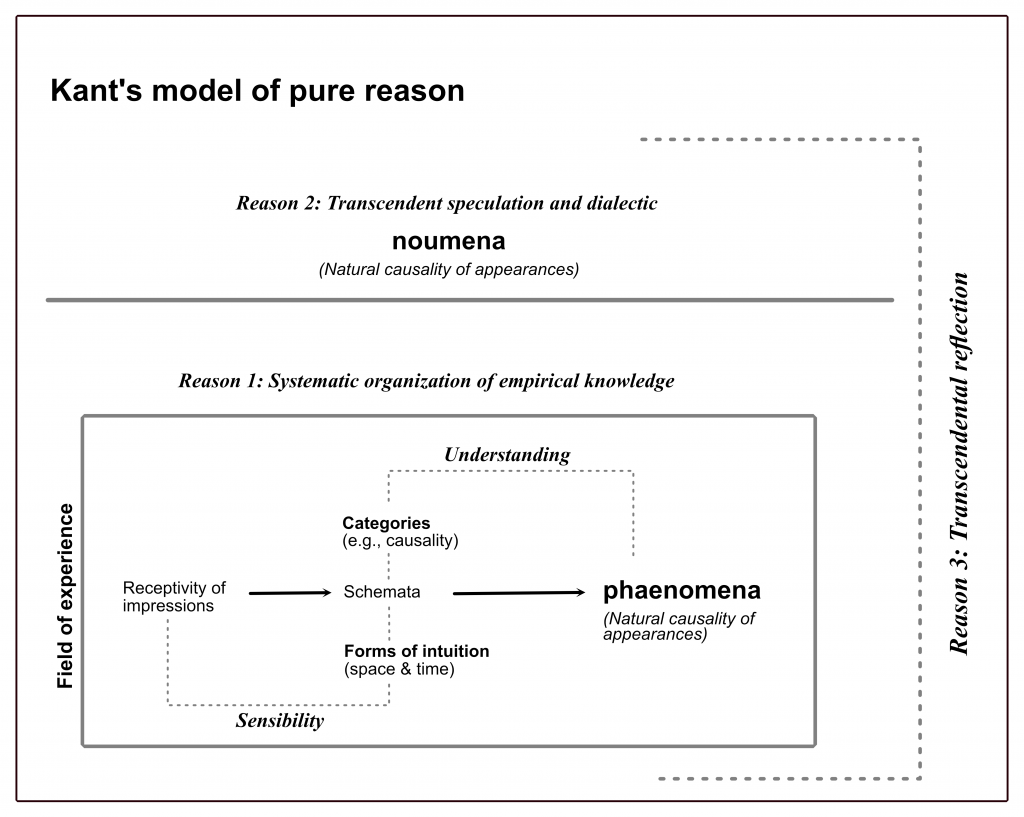
<p>To justify his claim that the objective world conforms to human thought, Kant built the intricate machinery of the <em>Transcendental Analytic</em>. As detailed in Chapter 7 of <em>The Long Farewell to Immanuel Kant</em>, his system stands or falls on three interwoven deductions:</p>
<ol class="wp-block-list" start="1">
<li><strong>The Metaphysical Deduction:</strong> Kant attempts to deduce twelve pure categories of the understanding (including causality, substance, and modality) directly from traditional table of logical judgments, asserting they are universal, immutable thought-forms.</li>
<li><strong>The Transcendental Deduction:</strong> Kant introduces the <em>transcendental unity of apperception</em> (the synthetic "I think" that must accompany all representations). He claims that we can only experience objects because the understanding actively synthesizes raw sensory impressions using these categories.</li>
<li><strong>The Subjective Deduction:</strong> Kant bridges abstract categories and raw sensory intuitions via the <em>transcendental schema</em> and the pure <em>a priori</em> forms of space and time.</li>
</ol>
<h4 class="wp-block-heading">The Missing Link: The Abolition of Epistemology</h4>
<p>What happens to the external, physical world in this construction? It vanishes.</p>
<p>Kant rejects the <strong>correspondence theory of truth</strong> (the foundational premise that our thoughts attempt to map an objectively existing material world). External reality is degraded into an indeterminate, unknowable limiting concept—a mere "Transcendental Object 'X'" that cannot even be said to cause our sensations, because causality is declared to exist solely inside our human understanding.</p>
<p>As Kant’s contemporary, the philosopher Friedrich Heinrich Jacobi, pointed out as early as 1787, Kant’s system is a radical form of subjective solipsism:</p>
<blockquote class="wp-block-quote">
<p><em>"In a double witch's smoke [...] haunting appearances that allow nothing to appear."</em></p>
<p> </p>
</blockquote>
<p>Jacobi recognized the central paradox: without the assumption of real external things affecting our senses, one cannot enter Kant’s system; but with that assumption, one cannot remain inside it without destroying its central logic.</p>
<h3 class="wp-block-heading">The 18th-Century Matrix</h3>
<p>To modern readers, Kant’s abstract transcendental machinery can seem bafflingly detached from reality. Yet pop culture provides an uncanny narrative analogy for the world Kant built: <strong>The Matrix</strong>.</p>
<figure class="post__image post__image--center"><img loading="lazy"  src="https://droste-effect.com/media/posts/116/Buch-IlluTranszentalPhilosophieEnglish-1024x817.png" alt="" sizes="(max-width: 1200px) 100vw, 1200px" srcset="https://droste-effect.com/media/posts/116/responsive/Buch-IlluTranszentalPhilosophieEnglish-1024x817-xs.png 300w ,https://droste-effect.com/media/posts/116/responsive/Buch-IlluTranszentalPhilosophieEnglish-1024x817-sm.png 480w ,https://droste-effect.com/media/posts/116/responsive/Buch-IlluTranszentalPhilosophieEnglish-1024x817-md.png 768w ,https://droste-effect.com/media/posts/116/responsive/Buch-IlluTranszentalPhilosophieEnglish-1024x817-xl.png 1200w ,https://droste-effect.com/media/posts/116/responsive/Buch-IlluTranszentalPhilosophieEnglish-1024x817-xxl.png 1600w ,https://droste-effect.com/media/posts/116/responsive/Buch-IlluTranszentalPhilosophieEnglish-1024x817-xxxl.png 2560w"></figure>
<p> </p>
<p>In the famous science-fiction film series, human beings live inside a total simulation generated by computer code. They perceive buildings, skies, and physical laws, but these are mere computational projections.</p>
<p>Kant’s transcendental philosophy functions identically:</p>
<ul class="wp-block-list">
<li>Space and time are the internal graphic rendering engines of human sensibility.</li>
<li>The categories of understanding (causality, substance) act as internal algorithms structuring the data feed.</li>
<li>The experienced world (<em>phenomena</em>) is entirely synthesized within our consciousness.</li>
</ul>
<p>Crucially, however, the Wachowskis’ cinematic Matrix allows for a "red pill"—an escape into the real, physical world. Kant’s philosophy offers no such exit. By design, Kant traps human reason inside its own subjective simulation forever, forbidding any cognitive access to objective material reality.</p>
<h3 class="wp-block-heading">The Neuroscientific Refutation: The Dynamic, Predictive Brain</h3>
<p>Why must 21st-century science and philosophy bid a definitive farewell to this Kantian construct? Because modern cognitive neuroscience and evolutionary biology have fundamentally disproven Kant’s static, subjectivist model.</p>
<p>Under modern <strong>Predictive Processing</strong> models of cognition (as articulated in contemporary computational neuroscience and rationality research):</p>
<ul class="wp-block-list">
<li><strong>The Brain is Not an A Priori Mold:</strong> The human brain does not impose rigid, innate <em>a priori</em> categories onto experience. Instead, it functions as a hierarchical Bayesian prediction machine. It continuously generates probabilistic hypotheses about external reality, compares them against incoming sensory data from the environment, calculates prediction errors, and updates its internal neural models accordingly.</li>
<li><strong>Realism Through Adaptation:</strong> Our representations of space, time, and causality are not disembodied mental filters. They are evolved, neurocomputational models that have adapted over millions of years of biological evolution to mirror the statistical regularities of an objective, physical world.</li>
<li><strong>Emergent Selfhood:</strong> The "I think" is not a static transcendental point of apperception, but an emergent biological process arising from dynamic interactions across the Default Mode Network (DMN) and Central Executive Network (CEN) in the prefrontal cortex.</li>
</ul>
<p>Cognition is not an inside-out construction of the universe; it is a bidirectional, continuous, self-correcting dialogue between an embodied organism and an objective material reality.</p>
<h3 class="wp-block-heading">The Tragic Trade-Off: Sacrificing Reality for Moral Dogma</h3>
<p>Why did Kant go to such extraordinary lengths to construct this solipsistic labyrinth?</p>
<p>As we saw in previous weeks, Kant’s primary motivation was never pure epistemology. He was determined to reconcile two warring principles: <strong>unbroken natural causality</strong> (to satisfy Newtonian mechanics) and <strong>transcendental human freedom</strong> (to safeguard Lutheran moral duty).</p>
<p>To resolve this tension, Kant split the human being into two irreconcilable halves:</p>
<ol class="wp-block-list" start="1">
<li><strong>The Empirical Character:</strong> Fully determined by natural laws, physics, and biology (belonging to <em>phenomena</em>).</li>
<li><strong>The Intelligible Character:</strong> Completely free, timeless, and autonomous (belonging to <em>noumena</em>).</li>
</ol>
<p>The price of this artificial compromise was catastrophic. In the Dialectic of the first Critique, Kant was forced to draw the devastating conclusion:</p>
<blockquote class="wp-block-quote">
<p><em>"The actual morality of actions (merit and guilt), even that of our own conduct, remains therefore entirely hidden from us."</em> (CPR, A 551 / B 579)</p>
</blockquote>
<p>By divorcing human freedom from the physical universe, Kant rendered moral autonomy empirically unverifiable and practically inaccessible. He sacrificed our connection to the objective material world, only to leave us with an empty, disembodied shadow of morality.</p>
<h3 class="wp-block-heading">Escaping the Solipsistic Bubble</h3>
<p>The verdict of modern scientific realism is unmistakable: Kant’s "Copernican Revolution" was a profound misnomer that led Western philosophy down the dead-end street of subjective idealism.</p>
<p>True Enlightenment in the 21st century requires the courage to dismantle this cognitive prison. We do not construct the universe from pure reason. We are embodied biological organisms exploring, testing, and understanding a real, evolving material reality.</p>
<p><em>Next week in Part 5:</em> <strong>The Categorical Imperative on Trial</strong>—we examine why Kant’s duty-ethics collapses when confronted with Jonathan Haidt’s moral psychology and Mario Bunge's Agathonic ethics.</p>
<h3 data-path-to-node="35">Where to Obtain the Book, eBook &amp; AI-Audiobook</h3>
<p data-path-to-node="36">The full, evidence-based deconstruction of Immanuel Kant’s scientific, epistemological, and moral legacy is available now across international formats:</p>
<p> </p>
<ul>
<li>📚 <strong>Paperback Edition:</strong> Available via major booksellers and online retailers. 👉 <a href="https://droste-effect.com/abschied-fuer-presse/">Order the Paperback on Amazon / Booksellers</a></li>
<li>📱 <strong>eBook Edition (Kindle / ePub):</strong> Instantly downloadable for e-readers and digital libraries. 👉 <a href="https://droste-effect.com/abschied-fuer-presse/">Get the Digital eBook Edition</a></li>
<li>🎧 <strong>AI-Voiced Audiobook (ElevenReader):</strong> Listen to the professionally voiced audiobook edition directly on ElevenReader. 👉 <a href="https://elevenreader.io/audiobooks/the-long-farewell-to-immanuel-kant-audiobook/7WQgYKx5fs2bCnHN2K9w" target="_blank" rel="noopener">Listen to the Audiobook on ElevenReader</a></li>
<li>📰 <strong>Press Center &amp; Review Copies:</strong> Journalists, reviewers, and podcast hosts can access full press releases, media kits, and sample chapters on the official press page: 👉 <a href="https://droste-effect.com/abschied-fuer-presse/">Visit the Official Kant Press Center</a></li>
</ul>
<p> </p>
<div class="wp-block-buttons">
<p> </p>
<div class="wp-block-button has-custom-width wp-block-button__width-75 is-style-fill"><a class="wp-block-button__link has-theme-palette-14-background-color has-background align-center has-medium-font-size has-custom-font-size wp-element-button" href="https://tideturn.substack.com">Subscribe to my Substack Newsletter for deep dives</a></div>
<p> </p>
</div>
<p> </p>
<p> </p>
<p> </p>
<p> </p>
            ]]>
        </content>
    </entry>
    <entry>
        <title>The Dogmatic Slumber Fallacy: Why David Hume Woke Immanuel Kant to Save Faith and Duty, Not Empirical Science</title>
        <author>
            <name>Heinz W. Droste</name>
        </author>
        <link href="https://droste-effect.com/the-dogmatic-slumber-fallacy-why-david-hume-woke-immanuel-kant-to-save-faith-and-duty-not-empirical-science/"/>
        <id>https://droste-effect.com/the-dogmatic-slumber-fallacy-why-david-hume-woke-immanuel-kant-to-save-faith-and-duty-not-empirical-science/</id>
        <media:content url="https://droste-effect.com/media/posts/115/Ebisode3_Aufmacher.jpg" medium="image" />
            <category term="Rationalität"/>

        <updated>2026-08-11T14:52:52+02:00</updated>
            <summary type="html">
                <![CDATA[
                        <img src="https://droste-effect.com/media/posts/115/Ebisode3_Aufmacher.jpg" alt="" />
                    In the annals of Western philosophical history, few anecdotes are quoted with such reverent regularity as Immanuel Kant’s dramatic&hellip;
                ]]>
            </summary>
        <content type="html">
            <![CDATA[
                    <p><img src="https://droste-effect.com/media/posts/115/Ebisode3_Aufmacher.jpg" class="type:primaryImage" alt="" /></p>
                <p>In the annals of Western philosophical history, few anecdotes are quoted with such reverent regularity as Immanuel Kant’s dramatic awakening from his "dogmatic slumber." In the preface to his <em>Prolegomena to Any Future Metaphysics</em> (1783), Kant famously made his monumental confession:</p>
<blockquote class="wp-block-quote">
<p><em>"I freely admit that the suggestion of David Hume was the very thing which many years ago first interrupted my dogmatic slumber and gave my investigations in the field of speculative philosophy a quite new direction."</em></p>
</blockquote>
<p>For over two centuries, university curricula and hagiographic biographies have presented this awakening as a heroic turning point in modern intellectual history. The standard narrative is well-rehearsed: David Hume’s radical Scottish empiricism had allegedly threatened to destroy the objective foundations of natural science and Newtonian causality. Kant, acting as the ultimate savior of reason, supposedly stepped into the breach to construct an unshakeable, <em>a priori</em> foundation that rescued empirical physics from the abyss of total skepticism.</p>
<p>However, when we subject Kant’s intellectual shift to a rigorous, contextualized examination—drawing on modern philosophy of science, historical text analysis, and cognitive science—this noble rescue narrative dissolves into myth. <strong>Kant was not awakened by Hume to defend scientific realism; he was deeply alarmed by Hume because empiricism threatened the rational foundation of Lutheran morality, disembodied duty, and theological metaphysics.</strong></p>
<h4 class="wp-block-heading">Hume’s Radical Challenge: Deconstructing the Metaphysical Scaffold</h4>
<p>To understand Kant’s true panic, one must first look at what David Hume actually argued. In his <em>An Enquiry Concerning Human Understanding</em> (1748), Hume subjected the concept of causality to relentless empirical scrutiny. He pointed out that when we observe one physical event following another—such as one billiard ball striking another—we never actually perceive an invisible, necessary metaphysical tie called "causality." We merely perceive <em>constant conjunction</em>: one event reliably preceding another in space and time.</p>
<p>From this, Hume deduced that our belief in causal necessity is not derived from pure logic or <em>a priori</em> insights into the essence of reality, but from psychological habit, custom, and associative expectations.</p>
<p>For physical science, Hume’s insight was far from destructive; it was functionally liberating. It reframed scientific laws as empirical hypotheses—fallible, probabilistic models of nature that must be continuously tested, revised, and validated through observation.</p>
<p>For traditional metaphysics, however, Hume’s empiricism was a fatal catastrophe. If causality could not be proven with absolute, necessary certainty by pure reason alone, then the entire rationalist architecture of Western theology collapsed:</p>
<ul class="wp-block-list">
<li>The classical cosmological proofs for the existence of God (as the "First Cause") lost their logical necessity.</li>
<li>The concept of an immortal, immaterial soul detached from physical matter became empirically unprovable.</li>
<li>Most crucially for Kant, moral duty could no longer be claimed as an absolute, objective law derived from disembodied rational necessity.</li>
</ul>
<figure class="post__image"><img loading="lazy"  src="https://droste-effect.com/media/posts/115/AufmacherEpisode3-1024x559.jpg" alt="" sizes="(max-width: 1200px) 100vw, 1200px" srcset="https://droste-effect.com/media/posts/115/responsive/AufmacherEpisode3-1024x559-xs.jpg 300w ,https://droste-effect.com/media/posts/115/responsive/AufmacherEpisode3-1024x559-sm.jpg 480w ,https://droste-effect.com/media/posts/115/responsive/AufmacherEpisode3-1024x559-md.jpg 768w ,https://droste-effect.com/media/posts/115/responsive/AufmacherEpisode3-1024x559-xl.jpg 1200w ,https://droste-effect.com/media/posts/115/responsive/AufmacherEpisode3-1024x559-xxl.jpg 1600w ,https://droste-effect.com/media/posts/115/responsive/AufmacherEpisode3-1024x559-xxxl.jpg 2560w"></figure>
<h4 class="wp-block-heading">The Strategic Counter-Attack: Making Room for Faith</h4>
<p>Kant recognized that if Hume’s radical empiricism gained dominance across Europe, philosophy would be stripped of its ability to decree absolute moral imperatives and metaphysical truths. His response was not to embrace empirical scientific realism, but to engineer an elaborate epistemological compromise designed to insulate traditional Lutheran dogmas from empirical refutation.</p>
<p>Kant famously exposed his true underlying agenda in the preface to the second edition of the <em>Critique of Pure Reason</em> (1787):</p>
<blockquote class="wp-block-quote">
<p><em>"I had to deny knowledge in order to make room for faith."</em> (<em>"Ich musste also das Wissen aufheben, um zum Glauben Platz zu bekommen."</em>)</p>
</blockquote>
<p>This single admission reveals the core driver of the entire Kantian enterprise. Kant’s transcendental framework was deliberately designed to construct an epistemological barrier between human cognition and the material world:</p>
<ol class="wp-block-list" start="1">
<li><strong>Internalizing Causality as an A Priori Category:</strong> To defeat Hume’s psychological habit argument, Kant declared that causality is neither an objective property of the material world nor an empirical habit. Instead, he claimed it is a mandatory, <em>a priori</em> subjective filter—a synthetic category built directly into the hardwiring of the human mind (<em>Verstandesbegriff</em>).</li>
<li><strong>Dividing the Cosmos: Phenomena vs. Noumena:</strong> By asserting that we can only know <em>phenomena</em> (things as they appear through our subjective cognitive filters), Kant relegated the actual objective world—the "thing-in-itself" (<em>Ding an sich</em>)—to an unknowable realm of <em>noumena</em>.</li>
<li><strong>Reinstating God and Free Will as Practical Postulates:</strong> Having successfully locked empirical science inside the bounded sphere of subjective appearances, Kant declared the supersensible noumenal realm safe from scientific refutation. In his <em>Critique of Practical Reason</em> (1788), he smuggled God, free will, and the immortality of the soul right back into philosophy—not as empirically verifiable facts, but as non-negotiable "postulates" required to sustain his rigid, duty-bound moral ethics.</li>
</ol>
<h4 class="wp-block-heading">Scientific Realism vs. The Transcendental Trap</h4>
<p>When evaluated through the exact philosophy of science pioneered by Mario Bunge, Kant’s "transcendental rescue" of causality reveals itself as an epistemological step backward.</p>
<p>Modern scientific realism does not require causality to be a subjective human mental filter. Nor does it view the material world as an unknowable "thing-in-itself." Objective reality exists independently of human consciousness. Causality, within modern physics and systems theory, is recognized as a real, physical property of energy transformations and structural interactions between physical systems—a property that human beings discover through empirical experimentation and mathematical modeling, not through armchair <em>a priori</em> deduction.</p>
<p>By internalizing causality and declaring external reality unknowable, Kant did not save science from Hume; he trapped European philosophy in a solipsistic, subject-centered bubble. He replaced the open-ended pursuit of empirical truth with a self-contained, dogmatic cognitive prosthesis.</p>
<h4 class="wp-block-heading">Cognitive Psychology: The Search for Emotional Reassurance</h4>
<p>Why did Kant’s solution gain such overwhelming popularity among German academics and intellectuals?</p>
<p>As modern rationality research (such as Keith Stanovich’s work on cognitive biases and the Rationality Quotient) illuminates, human cognition exhibits a strong bias toward structures that provide certainty and reduce existential anxiety. Kant’s philosophy offered an extraordinary psychological comfort: it allowed 18th- and 19th-century intellectuals to pretend they were champions of modern reason, while simultaneously preserving their pietistic moral instincts and religious worldviews intact.</p>
<p>Kant offered a compromise that required no empirical sacrifice. It provided a closed mental scaffolding where duty remained absolute, God remained necessary, and the discomfort of living in a fallback-free, evolving material universe could be comfortably ignored.</p>
<h4 class="wp-block-heading">What’s Coming Next in Week 4</h4>
<p> </p>
<p>Next week, in <strong>Part 4: The Copernican Revolution or Ptolemaic Relapse?</strong>, we will dismantle the central crown jewel of Kant’s epistemology: transcendental idealism. We will explore how Kant’s attempt to place the human mind at the center of the universe was not a revolutionary leap forward, but a reactionary retreat into an 18th-century precursor of "The Matrix."</p>
<h3 data-path-to-node="35">Where to Obtain the Book, eBook &amp; AI-Audiobook</h3>
<p data-path-to-node="36">The full, evidence-based deconstruction of Immanuel Kant’s scientific, epistemological, and moral legacy is available now across international formats:</p>
<p> </p>
<ul>
<li>📚 <strong>Paperback Edition:</strong> Available via major booksellers and online retailers. 👉 <a href="https://droste-effect.com/abschied-fuer-presse/">Order the Paperback on Amazon / Booksellers</a></li>
<li>📱 <strong>eBook Edition (Kindle / ePub):</strong> Instantly downloadable for e-readers and digital libraries. 👉 <a href="https://droste-effect.com/abschied-fuer-presse/">Get the Digital eBook Edition</a></li>
<li>🎧 <strong>AI-Voiced Audiobook (ElevenReader):</strong> Listen to the professionally voiced audiobook edition directly on ElevenReader. 👉 <a href="https://elevenreader.io/audiobooks/the-long-farewell-to-immanuel-kant-audiobook/7WQgYKx5fs2bCnHN2K9w" target="_blank" rel="noopener">Listen to the Audiobook on ElevenReader</a></li>
<li>📰 <strong>Press Center &amp; Review Copies:</strong> Journalists, reviewers, and podcast hosts can access full press releases, media kits, and sample chapters on the official press page: 👉 <a href="https://droste-effect.com/abschied-fuer-presse/">Visit the Official Kant Press Center</a></li>
</ul>
<div class="wp-block-buttons">
<div class="wp-block-button has-custom-width wp-block-button__width-75 is-style-fill"><a class="wp-block-button__link has-theme-palette-14-background-color has-background align-center has-medium-font-size has-custom-font-size wp-element-button" href="https://tideturn.substack.com">Subscribe to my Substack Newsletter for deep dives</a></div>
</div>
<p> </p>
            ]]>
        </content>
    </entry>
    <entry>
        <title>The Scientific Genius Myth: Did Immanuel Kant Truly Understand Physics?</title>
        <author>
            <name>Heinz W. Droste</name>
        </author>
        <link href="https://droste-effect.com/the-scientific-genius-myth-did-immanuel-kant-truly-understand-physics/"/>
        <id>https://droste-effect.com/the-scientific-genius-myth-did-immanuel-kant-truly-understand-physics/</id>
        <media:content url="https://droste-effect.com/media/posts/114/Episode3Aufmacher2.jpg" medium="image" />
            <category term="Kant-Kritik"/>
            <category term="In English"/>

        <updated>2026-08-04T12:04:00+02:00</updated>
            <summary type="html">
                <![CDATA[
                        <img src="https://droste-effect.com/media/posts/114/Episode3Aufmacher2.jpg" alt="" />
                    In standard histories of Western thought, Immanuel Kant is celebrated not only as a titan of philosophy, but as&hellip;
                ]]>
            </summary>
        <content type="html">
            <![CDATA[
                    <p><img src="https://droste-effect.com/media/posts/114/Episode3Aufmacher2.jpg" class="type:primaryImage" alt="" /></p>
                <p>In standard histories of Western thought, Immanuel Kant is celebrated not only as a titan of philosophy, but as a groundbreaking scientific visionary. Popular accounts and academic textbooks routinely credit him with two monumental achievements: proposing the nebular hypothesis of solar system formation—commonly dubbed the "Kant-Laplace hypothesis"—and providing the ultimate, irreversible epistemological foundation for Isaac Newton’s classical mechanics.</p>
<p>However, when we subject Kant’s physical and cosmological writings to rigorous examination through modern physics, celestial mechanics, and exact philosophy of science, a startling truth comes to light: <strong>Kant’s reputation as a scientific genius is largely a retrospective academic construction.</strong></p>
<h4 class="wp-block-heading">The Cosmology Myth: Speculation Without Mathematics</h4>
<p>In 1755, the young Kant anonymously published his <em>Universal Natural History and Theory of the Heavens</em>. In this ambitious work, he attempted to explain the origin and mechanical evolution of the universe from a primeval dust cloud, relying solely on attractive and repulsive forces. While literary figures have praised this as a brilliant intuitive leap, Kant’s physical model suffered from fatal scientific flaws.</p>
<p>Unlike the mathematician Pierre-Simon Laplace, who independently formulated a mathematically coherent nebular hypothesis four decades later based on fluid dynamics and Newtonian mechanics, Kant lacked advanced mathematical training. Crucially, Kant's physical reasoning violated fundamental conservation principles of physics—most notably the <strong>law of conservation of angular momentum</strong>.</p>
<p>Kant mistakenly assumed that a completely stationary cloud of particles, interacting purely through internal gravitational attraction, could spontaneously induce a net rotation of the entire system. In Newtonian mechanics, an isolated physical system cannot generate net angular momentum from internal central forces alone. What Kant presented was not a rigorous mathematical-physical theory, but a speculative natural philosophy (<em>Naturphilosophie</em>) disguised as Newtonian physics.</p>
<h4 class="wp-block-heading">Subjugating Physics to Transcendental Dogma</h4>
<p>In his later critical phase, particularly in <em>Metaphysical Foundations of Natural Science</em> (1786), Kant sought to "anchor" physics by deriving Newton's laws from pure <em>a priori</em> concepts of reason.</p>
<p>Instead of opening physics to empirical revision, Kant’s transcendental framework erected significant barriers to future scientific discovery:</p>
<ol class="wp-block-list" start="1">
<li><strong>The Euclidean Space Trap:</strong> Kant declared Euclidean space and absolute time to be necessary, unalterable <em>a priori</em> forms of human intuition. Rather than anticipating modern physics, this dogmatic framing actively hindered the conceptual acceptance of non-Euclidean geometries and, ultimately, Albert Einstein’s theory of relativity.</li>
<li><strong>Dynamism vs. Atomic Science:</strong> Kant rejected atomic theory and insisted on reducing matter entirely to continuously distributed attractive and repulsive forces. This speculative "dynamism" disconnected Kantian philosophy from the developing empirical chemistry and molecular theory of the 19th century.</li>
<li><strong>A Priori Deduction vs. Scientific Realism:</strong> For Isaac Newton, physical principles were hypotheses subject to mathematical formulation and empirical testing. For Kant, physics had to be subjugated to transcendental philosophy.</li>
</ol>
<figure class="post__image post__image--center"><img loading="lazy"  src="https://droste-effect.com/media/posts/114/Episode2Aufmacher2-1024x1024.jpg" alt="" sizes="(max-width: 1200px) 100vw, 1200px" srcset="https://droste-effect.com/media/posts/114/responsive/Episode2Aufmacher2-1024x1024-xs.jpg 300w ,https://droste-effect.com/media/posts/114/responsive/Episode2Aufmacher2-1024x1024-sm.jpg 480w ,https://droste-effect.com/media/posts/114/responsive/Episode2Aufmacher2-1024x1024-md.jpg 768w ,https://droste-effect.com/media/posts/114/responsive/Episode2Aufmacher2-1024x1024-xl.jpg 1200w ,https://droste-effect.com/media/posts/114/responsive/Episode2Aufmacher2-1024x1024-xxl.jpg 1600w ,https://droste-effect.com/media/posts/114/responsive/Episode2Aufmacher2-1024x1024-xxxl.jpg 2560w"></figure>
<h4 class="wp-block-heading">Scientific Realism vs. Idealist Hagiography</h4>
<p>Why has the image of Kant as a scientific polymath endured for over two centuries?</p>
<p>Because the 19th-century German idealist tradition required an iconic figurehead who could bridge hard natural science and traditional metaphysics. By portraying Kant as the thinker who "understood Newton better than Newton understood himself," academic philosophy attempted to assert its dominance over the rising empirical sciences.</p>
<p>As I demonstrate in <em>The Long Farewell to Immanuel Kant</em>—drawing on the exact philosophy of science developed by Mario Bunge—real scientific progress does not stem from constructing <em>a priori</em> armchair theories. Science demands <strong>scientific realism</strong>: an ongoing, self-correcting dialogue between mathematical modeling and empirical testing, free from metaphysical dogmas that claim to know the nature of reality prior to experience.</p>
<h4 class="wp-block-heading">Coming Up Next in Week 3</h4>
<p>Next week, we examine one of the most famous anecdotes in intellectual history: Kant’s claim that reading David Hume "interrupted his dogmatic slumber." We will reveal why Hume’s skepticism alarmed Kant primarily for theological and moral reasons—not scientific ones.</p>
<p>It is time to discard the cognitive prosthesis and rediscover an unencumbered, evidence-based Enlightenment fit for the challenges of the 21st century.</p>
<h3>Where to Obtain the Book, eBook &amp; AI-Audiobook</h3>
<figure class="post__image post__image--center"><img loading="lazy"  src="https://droste-effect.com/media/posts/114/FreistellerFokus-300x223.jpg" alt="" width="300" height="223" sizes="(max-width: 1200px) 100vw, 1200px" srcset="https://droste-effect.com/media/posts/114/responsive/FreistellerFokus-300x223-xs.jpg 300w ,https://droste-effect.com/media/posts/114/responsive/FreistellerFokus-300x223-sm.jpg 480w ,https://droste-effect.com/media/posts/114/responsive/FreistellerFokus-300x223-md.jpg 768w ,https://droste-effect.com/media/posts/114/responsive/FreistellerFokus-300x223-xl.jpg 1200w ,https://droste-effect.com/media/posts/114/responsive/FreistellerFokus-300x223-xxl.jpg 1600w ,https://droste-effect.com/media/posts/114/responsive/FreistellerFokus-300x223-xxxl.jpg 2560w"></figure>
<p>The full, uncompromised investigation is available now across international formats:</p>
<ul>
<li>📚 <strong>Paperback Edition:</strong> Available via major booksellers and online retailers. 👉 <a href="https://droste-effect.com/abschied-fuer-presse/">Order the Paperback on Amazon / Booksellers</a></li>
<li>📱 <strong>eBook Edition (Kindle / ePub):</strong> Instantly downloadable for e-readers and digital libraries. 👉 <a href="https://droste-effect.com/abschied-fuer-presse/">Get the Digital eBook Edition</a></li>
<li>🎧 <strong>AI-Voiced Audiobook (ElevenReader):</strong> Listen to the professionally voiced audiobook edition directly on ElevenReader. 👉 <a href="https://elevenreader.io/audiobooks/the-long-farewell-to-immanuel-kant-audiobook/7WQgYKx5fs2bCnHN2K9w" target="_blank" rel="noopener">Listen to the Audiobook on ElevenReader</a></li>
<li>📰 <strong>Press Center &amp; Review Copies:</strong> Journalists, reviewers, and podcast hosts can access full press releases, media kits, and sample chapters on the official press page: 👉 <a href="https://droste-effect.com/abschied-fuer-presse/">Visit the Official Kant Press Center</a></li>
</ul>
<div class="wp-block-buttons">
<div class="wp-block-button has-custom-width wp-block-button__width-75 is-style-fill"><a class="wp-block-button__link has-theme-palette-14-background-color has-background align-center has-medium-font-size has-custom-font-size wp-element-button" href="https://tideturn.substack.com">Subscribe to my Substack Newsletter for deep dives</a></div>
</div>
<p> </p>
<p> </p>
            ]]>
        </content>
    </entry>
    <entry>
        <title>The Cognitive Prosthesis: Why We Turn Immanuel Kant into an Intellectual Crutch</title>
        <author>
            <name>Heinz W. Droste</name>
        </author>
        <link href="https://droste-effect.com/the-cognitive-prosthesis-why-we-turn-immanuel-kant-into-an-intellectual-crutch/"/>
        <id>https://droste-effect.com/the-cognitive-prosthesis-why-we-turn-immanuel-kant-into-an-intellectual-crutch/</id>
        <media:content url="https://droste-effect.com/media/posts/113/AufmacherEpisode_1.jpg" medium="image" />
            <category term="Kant-Kritik"/>

        <updated>2026-07-28T16:36:39+02:00</updated>
            <summary type="html">
                <![CDATA[
                        <img src="https://droste-effect.com/media/posts/113/AufmacherEpisode_1.jpg" alt="" />
                    For over two centuries, Western intellectual culture has revered Immanuel Kant as the ultimate lighthouse of the Enlightenment, the&hellip;
                ]]>
            </summary>
        <content type="html">
            <![CDATA[
                    <p><img src="https://droste-effect.com/media/posts/113/AufmacherEpisode_1.jpg" class="type:primaryImage" alt="" /></p>
                <p>For over two centuries, Western intellectual culture has revered Immanuel Kant as the ultimate lighthouse of the Enlightenment, the undisputed architect of modern reason, and the intellectual father of human autonomy. In academic lecture halls, philosophical treatises, and public commemorations, we are repeatedly taught to recite his three cardinal questions as if they were holy scripture:</p>
<ol>
<li><em>What can I know?</em></li>
<li><em>What ought I to do?</em></li>
<li><em>What may I hope?</em></li>
</ol>
<p>To the modern educated reader, these three questions sound like a noble, liberating blueprint for human self-determination. But if we dismantle this hagiography through the lens of modern cognitive psychology, evolutionary epistemologies, and modern philosophy of science, a startling paradox emerges: <strong>Kant’s foundational triad has not liberated human thinking—it has systematically replaced it.</strong></p>
<h4>The Myth of Germany's "National Saint"</h4>
<p>In 2024, academic institutions and the public sphere celebrated Immanuel Kant’s 300th birth anniversary with predictable, ceremonial praise. Yet behind the celebratory rhetoric lies an inconvenient truth that traditional Kantian scholars routinely ignore. Rather than urging us toward empirical reality and open-ended scientific investigation, Kant constructed an elaborate, closed mental fortress designed to protect speculative metaphysics from the radical, empiricist pressures of the European Enlightenment.</p>
<p>In modern cognitive psychology—specifically within the heuristics-and-biases tradition and Keith Stanovich’s groundbreaking research on the <em>Rationality Quotient</em> (RQ) and the Comprehensive Assessment of Rational Thinking (CART)—we recognize a fundamental human trait: <em>cognitive miserliness</em>. The human brain constantly seeks shortcuts (<em>mindware</em>) that minimize processing effort. We crave overarching, static frameworks that tell us in advance how the world is structured, what moral duties we must execute without question, and what ultimate purpose we are permitted to hope for.</p>
<p>Kant supplied precisely this demand: a sophisticated, highly systemized "cognitive prosthesis."</p>
<h4>From Autonomy to Dogmatic Comfort</h4>
<p>Instead of encouraging open-ended, evidence-based inquiry into the natural and social world, Kantian idealism turned the mind strictly inward. Kant claimed that the fundamental framework of reality—including space, time, and causality—does not belong to the physical world itself, but represents mere <em>a priori</em> conditions of human intuition.</p>
<p>As I demonstrate in my book, <em>The Long Farewell to Immanuel Kant</em>, this subject-centered "Copernican turn" was not a progressive leap forward. On the contrary, when analyzed through the exact philosophy of science pioneered by Mario Bunge, real scientific progress depends on <em>scientific realism</em>—the unequivocal recognition that an objective, material universe exists independent of human consciousness, and that our understanding of this world must be continuously tested, corrected, and updated by empirical data.</p>
<p>By insulating his epistemology from empirical testing and reducing external reality to an unknowable "thing-in-itself" (<em>Ding an sich</em>), Kant did not liberate the mind; he trapped it in a solipsistic bubble. Kant became a convenience—a book that thinks <em>for</em> us, sparing us the intellectual discomfort of dealing with fallback-free, evolving empirical truths.</p>
<h4>The Dual-Process Fallacy and Moral Rigorism</h4>
<p>Modern neuroscience and cognitive research show that human decision-making relies on dynamic interactions between brain networks (such as the Default Mode Network, DMN, and the Central Executive Network, CEN) and complex emotional-moral intuitions (as illuminated by Jonathan Haidt's moral psychology).</p>
<p>Kant's rigid categorical imperative, by contrast, demands the complete suppression of empirical context, emotional empathy, and real-world consequences in favor of pure, disembodied duty. This disembodied rationalism is not only psychologically unrealistic; it laid the groundwork for an authoritarian "dictatorship of reason" that prioritizes blind obedience to abstract law over human well-being and empirical moral outcomes.</p>
<figure class="post__image post__image--center"><img loading="lazy"  src="https://droste-effect.com/media/posts/113/EEpisode_1-300x300.jpg" alt="" width="300" height="300" sizes="(max-width: 1200px) 100vw, 1200px" srcset="https://droste-effect.com/media/posts/113/responsive/EEpisode_1-300x300-xs.jpg 300w ,https://droste-effect.com/media/posts/113/responsive/EEpisode_1-300x300-sm.jpg 480w ,https://droste-effect.com/media/posts/113/responsive/EEpisode_1-300x300-md.jpg 768w ,https://droste-effect.com/media/posts/113/responsive/EEpisode_1-300x300-xl.jpg 1200w ,https://droste-effect.com/media/posts/113/responsive/EEpisode_1-300x300-xxl.jpg 1600w ,https://droste-effect.com/media/posts/113/responsive/EEpisode_1-300x300-xxxl.jpg 2560w"></figure>
<h4>What to Expect in This 8-Part Series</h4>
<p>Over the next seven weeks, this series will systematically dismantle the major myths surrounding the "Mandarin of Königsberg":</p>
<ul>
<li><strong>Week 2:</strong> The Scientific Genius Myth (Kant’s physical errors, cosmological missteps, and Newtonian misunderstandings).</li>
<li><strong>Week 3:</strong> The Dogmatic Slumber Fallacy (Why David Hume woke Kant for theological and moral preservation, not physics).</li>
<li><strong>Week 4:</strong> Ptolemaic Relapse (Transcendental idealism, the solipsistic matrix, and the rejection of realism).</li>
<li><strong>Week 5:</strong> The Categorical Imperative on Trial (Duty ethics vs. modern moral psychology and Mario Bunge's Agathonic imperative).</li>
<li><strong>Week 6:</strong> The Theological Trap (How Kant salvaged Lutheran dogma under the guise of pure reason).</li>
<li><strong>Week 7:</strong> Anthropology &amp; Intellectual Racism (How Kantian rational hierarchy was used to justify racial inequality).</li>
<li><strong>Week 8:</strong> A New Compass for the 21st Century (Fritz Bauer's legal critique, church obedience, and the path to an empirical, secular ethics).</li>
</ul>
<p>It is time to discard the cognitive prosthesis and rediscover an unencumbered, evidence-based Enlightenment fit for the challenges of the 21st century.</p>
<h3>Where to Obtain the Book, eBook &amp; AI-Audiobook</h3>
<figure class="post__image post__image--center"><img loading="lazy"  src="https://droste-effect.com/media/posts/113/FreistellerFokus-300x223.jpg" alt="" width="300" height="223" sizes="(max-width: 1200px) 100vw, 1200px" srcset="https://droste-effect.com/media/posts/113/responsive/FreistellerFokus-300x223-xs.jpg 300w ,https://droste-effect.com/media/posts/113/responsive/FreistellerFokus-300x223-sm.jpg 480w ,https://droste-effect.com/media/posts/113/responsive/FreistellerFokus-300x223-md.jpg 768w ,https://droste-effect.com/media/posts/113/responsive/FreistellerFokus-300x223-xl.jpg 1200w ,https://droste-effect.com/media/posts/113/responsive/FreistellerFokus-300x223-xxl.jpg 1600w ,https://droste-effect.com/media/posts/113/responsive/FreistellerFokus-300x223-xxxl.jpg 2560w"></figure>
<p>The full, uncompromised investigation is available now across international formats:</p>
<ul>
<li>📚 <strong>Paperback Edition:</strong> Available via major booksellers and online retailers. 👉 <a href="https://droste-effect.com/abschied-fuer-presse/">Order the Paperback on Amazon / Booksellers</a></li>
<li>📱 <strong>eBook Edition (Kindle / ePub):</strong> Instantly downloadable for e-readers and digital libraries. 👉 <a href="https://droste-effect.com/abschied-fuer-presse/">Get the Digital eBook Edition</a></li>
<li>🎧 <strong>AI-Voiced Audiobook (ElevenReader):</strong> Listen to the professionally voiced audiobook edition directly on ElevenReader. 👉 <a href="https://elevenreader.io/audiobooks/the-long-farewell-to-immanuel-kant-audiobook/7WQgYKx5fs2bCnHN2K9w" target="_blank" rel="noopener">Listen to the Audiobook on ElevenReader</a></li>
<li>📰 <strong>Press Center &amp; Review Copies:</strong> Journalists, reviewers, and podcast hosts can access full press releases, media kits, and sample chapters on the official press page: 👉 <a href="https://droste-effect.com/abschied-fuer-presse/">Visit the Official Kant Press Center</a></li>
</ul>
<div class="wp-block-buttons">
<div class="wp-block-button has-custom-width wp-block-button__width-75 is-style-fill"><a class="wp-block-button__link has-theme-palette-14-background-color has-background align-center has-medium-font-size has-custom-font-size wp-element-button" href="https://tideturn.substack.com">Subscribe to my Substack Newsletter for deep dives</a></div>
</div>
<p> </p>
            ]]>
        </content>
    </entry>
</feed>